
Bringing Intelligent Material Handling to the Garment Industry
As the global garment manufacturing industry continues to modernize, factories are increasingly looking for ways to improve internal logistics, reduce repetitive manual handling, and maintain a smooth flow of materials between production departments.
In traditional garment factories, workers often spend considerable time pushing material racks between warehouses, cutting areas, sewing lines, and finished-product sections. Although these transportation activities are essential to production, they can consume valuable labor resources and create unnecessary movement across the factory floor.
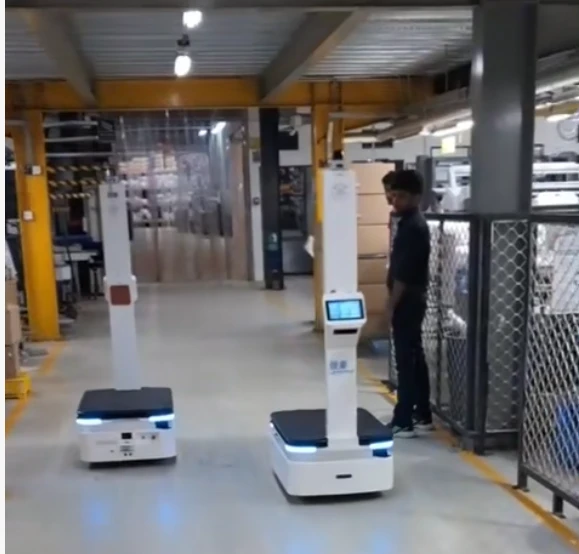
To improve its internal logistics operations, a garment manufacturing factory in Sri Lanka introduced two Reeman 300kg Fly Boat MAX autonomous mobile robots (AMRs) equipped with automatic lifting mechanisms and Reeman's LORA multi-robot scheduling system.
The deployment represents another practical application of autonomous mobile robots in the garment manufacturing industry, demonstrating how multiple AMRs can work together to automate material transportation in an existing factory environment.
1. The Challenge: Repetitive Material Transportation in Garment Manufacturing
Garment production involves multiple processes, from raw material preparation and fabric cutting to sewing, assembly, quality inspection, and packaging.
Materials and semi-finished products need to move continuously between different production areas. In conventional operations, these tasks are frequently handled by employees manually pushing wheeled material racks.
This creates several challenges:
Repetitive manual transportation takes employees away from production activities.
Material delivery depends on the availability of workers.
Frequent transportation increases physical workload.
Multiple material carts moving through the same areas can create congestion.
Coordinating deliveries between different production departments can become complicated.
The factory needed a more flexible transportation solution that could operate within its existing production environment and support multiple material delivery tasks.
Reeman proposed a two-robot AMR solution featuring automatic rack lifting and centralized multi-robot scheduling.
2. The Solution: Two 300kg Fly Boat MAX Lifting AMRs
The project introduced two Reeman Fly Boat MAX AMRs, each featuring a rated payload capacity of up to 300kg and an automatic lifting height of approximately 10cm.
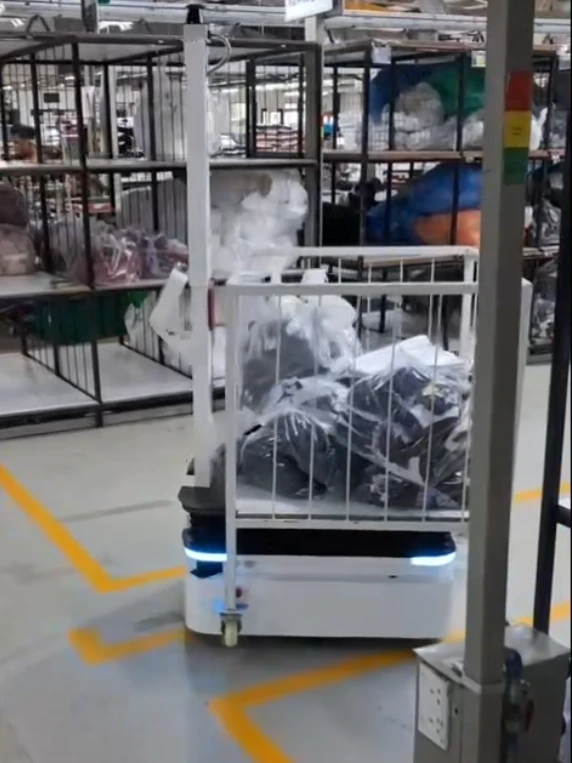
Unlike conventional mobile robots that simply carry materials on their platforms, the lifting AMR can move underneath compatible wheeled racks, raise them automatically, and transport them to designated destinations.
This makes the solution particularly suitable for garment factories that already use material racks and trolley-based transportation systems.
Key Product Features
300kg Payload Capacity
Each Fly Boat MAX has a rated payload capacity of up to 300kg, providing sufficient capacity for many industrial material transportation applications.
10cm Automatic Lifting
The integrated lifting mechanism allows the robot to pick up compatible material racks without requiring workers to manually transfer materials onto the robot.
Dual Laser SLAM Navigation
The robot uses dual laser SLAM navigation to build environmental maps and navigate autonomously without requiring magnetic strips or QR-code markers on the floor.
Autonomous Obstacle Detection
Laser LiDAR and additional sensors help the robot detect obstacles and respond according to its configured safety strategy.
Flexible Delivery Points
Pickup and delivery locations can be configured according to the factory's production workflow.
3. LORA Multi-Robot Scheduling: Two AMRs, One Intelligent System
One of the most important highlights of this project is the implementation of Reeman's LORA multi-robot scheduling system.
Deploying one AMR can automate an individual transportation task. However, when multiple robots operate in the same factory, coordinating their tasks becomes equally important.
Without centralized scheduling, robots may independently receive transportation requests, resulting in inefficient task allocation, unnecessary waiting, or conflicts along shared routes.
Reeman's LORA scheduling system provides centralized management for the two Fly Boat MAX robots.
Instead of treating each robot as an independent machine, the system coordinates their transportation tasks through a unified scheduling platform.
How Does Multi-Robot Scheduling Work?
Step 1 – Transportation Request
A transportation request is generated through the configured calling interface or task management workflow.
Step 2 – Centralized Task Management
The LORA scheduling system receives the transportation request and manages the available robot resources.
Step 3 – Robot Task Assignment
The system assigns the transportation task to an appropriate robot according to the configured scheduling rules and robot status.
Step 4 – Autonomous Material Pickup
The assigned Fly Boat MAX navigates to the pickup location and activates its lifting mechanism to collect the compatible material rack.
Step 5 – Coordinated Transportation
The robot transports the rack to the designated production workstation. Meanwhile, the scheduling platform manages the task status of both robots.
Step 6 – Task Completion
After delivery, the robot updates its task status and becomes available for subsequent transportation assignments.
Through centralized scheduling, the two AMRs can share the workload and execute multiple transportation tasks within the same factory environment.
4. Two Robots Working Together in an Existing Factory
For factories introducing automation for the first time, completely redesigning the production floor is often unnecessary and costly.
The Reeman Fly Boat MAX uses dual laser SLAM navigation, allowing it to operate according to a digital map of the factory environment.
During deployment, engineers configure the working area, navigation routes, pickup points, delivery destinations, and robot operating parameters.
The two robots can then perform transportation tasks along their designated routes.
The system is designed to support:
Autonomous navigation between configured workstations.
Centralized transportation task assignment.
Coordinated operation of multiple AMRs.
Obstacle detection in shared working environments.
Flexible adjustment of transportation routes.
Continuous material transportation between production areas.
This provides the factory with a more flexible logistics solution while reducing dependence on fixed physical navigation infrastructure.
5. Remote Deployment: Delivering Automation Across International Markets
Another important aspect of Reeman's overseas projects is the ability to provide remote technical assistance.
Deploying autonomous robots in another country can present several challenges, including geographical distance, installation coordination, navigation configuration, and communication between engineering teams.
For this project, Reeman's technical team worked with the customer's local engineers to support the robot deployment and system configuration.
The implementation process involved:
Robot setup and operational configuration.
Factory environment mapping.
Navigation route configuration.
Multi-robot scheduling setup.
Task testing and operational optimization.
Technical guidance and operator training.
Through online communication and continuous testing, the engineering teams worked together to establish the autonomous transportation workflow.
This demonstrates how overseas customers can receive technical assistance from Reeman without necessarily requiring a complete on-site engineering team for every deployment.
6. Why Are Multi-AMR Solutions Important for Garment Factories?
The successful introduction of two lifting AMRs provides a practical example of how automation can improve internal factory logistics.
Compared with relying entirely on manual transportation, a multi-AMR system offers several potential advantages.
Reduced Repetitive Manual Work
AMRs handle repetitive rack transportation, allowing employees to focus more on garment production activities.
Better Transportation Coordination
Centralized scheduling helps organize transportation tasks across multiple robots.
Improved Material Flow
Automated delivery supports a more organized movement of materials between production departments.
Flexible Production Logistics
The robot routes and delivery points can be configured according to factory requirements.
Expandable Automation
The multi-robot scheduling architecture provides a foundation for introducing additional robots as transportation requirements grow, subject to system capacity and project configuration.