

Bringing Autonomous Material Handling to Food Production Facilities
As food manufacturing continues to expand, factories are increasingly looking for smarter ways to transport materials between production areas, processing equipment, and designated storage locations.
In traditional food factories, material transportation often relies on employees manually operating forklifts or pushing heavy material carts. These repetitive activities require considerable labor and can create challenges in maintaining an efficient and organized production workflow.
To improve internal logistics, an Indonesian food manufacturing facility introduced the Reeman Ironhide 3.0 Autonomous Forklift for automated ground-level material transportation.
With a rated load capacity of 1.5 tons, the Ironhide 3.0 is designed to handle heavy material transportation tasks in industrial environments, helping manufacturers reduce repetitive manual handling and improve the efficiency of factory logistics.
1. The Application: Moving Heavy Materials Along Production Lines
Food manufacturing facilities often contain large processing machines, production equipment, material containers, and interconnected workstations.
Moving materials between these areas is an essential part of daily operations.
In this Indonesian factory, the application involves transporting industrial material containers in the production workshop. As shown in the project photo, the autonomous forklift operates alongside a production line, handling a stainless-steel material container mounted on a mobile platform.
This type of application highlights the potential of autonomous forklifts in factory environments where heavy materials need to be moved regularly without relying entirely on manual transportation.
Typical ground-level material handling tasks in food manufacturing may include:
Moving material containers between production areas.
Transporting raw materials to designated processing stations.
Transferring semi-finished products between workstations.
Moving heavy industrial containers along predefined routes.
Supporting internal logistics between production and storage areas.
By introducing autonomous transportation, factories can establish a more organized material handling process.
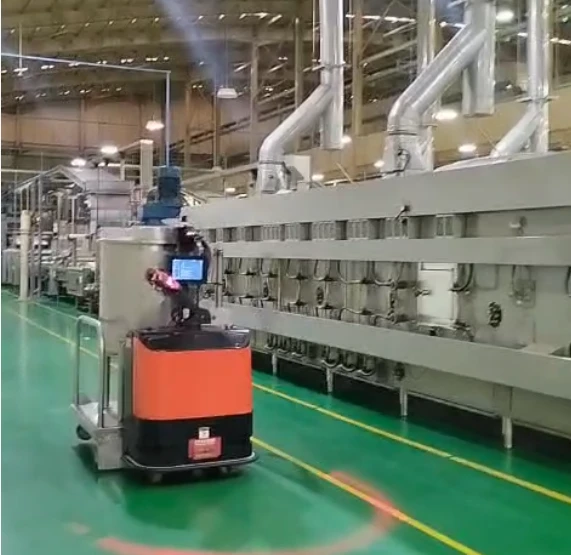
2. Reeman Ironhide 3.0: Designed for Heavy-Duty Ground Transportation
The Reeman Ironhide 3.0 is an autonomous forklift designed for industrial material handling applications.
With a rated load capacity of 1.5 tons, it provides a solution for factories that need to transport relatively heavy materials across production areas.
Unlike applications that primarily focus on high-level pallet stacking, this project emphasizes ground-level transportation.
The robot can be configured to travel between designated pickup and delivery locations, supporting repetitive transportation tasks within the factory.
Key features include:
1.5-Ton Load Capacity
Designed for industrial transportation tasks involving heavy loads, making it suitable for a variety of factory logistics applications.
Autonomous Navigation
The Ironhide 3.0 uses LiDAR-based navigation technology to perceive its surroundings and navigate along configured routes.
60m LiDAR and 3D Perception
Its navigation and perception configuration supports environmental detection and autonomous movement in industrial environments.
No Magnetic Strips or QR Codes Required
Laser-based navigation reduces dependence on physical navigation markers installed on the factory floor.
Autonomous Obstacle Detection
The robot detects obstacles within its configured safety zones and can stop when necessary to support safer operation around people and equipment.
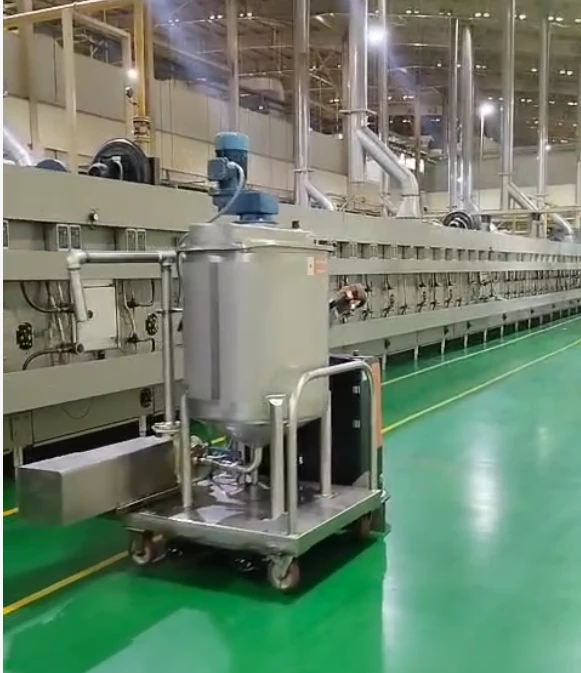
3. Automating Repetitive Transportation in Food Factories
One of the main benefits of introducing autonomous forklifts is the ability to automate repetitive transportation activities.
In conventional factory operations, employees may need to repeatedly move heavy containers between different production areas.
These activities take time and require workers to spend physical effort on transportation rather than other production responsibilities.
With the Ironhide 3.0, factories can configure predefined transportation routes and designated pickup and delivery points.
A typical automated workflow can include:
Step 1 – Task Assignment
A transportation task is assigned through the configured robot operation or dispatch system.
Step 2 – Autonomous Navigation
The Ironhide 3.0 travels toward the designated pickup location using its autonomous navigation system.
Step 3 – Material Handling
The forklift performs the configured pickup operation for a compatible load or transportation platform.
Step 4 – Ground-Level Transportation
The robot moves the load along its predefined route toward the target production area.
Step 5 – Delivery
After reaching the destination, the robot completes the configured delivery operation and becomes available for another task.
This approach helps manufacturers establish a more systematic transportation workflow and reduce repetitive manual material handling.
4. Why Are Autonomous Forklifts Valuable in Food Manufacturing?
Food manufacturing environments have specific operational requirements. Materials need to move efficiently between processing equipment, production stations, and storage areas.
Autonomous forklifts can help address several common challenges.
Reducing Manual Transportation
Automating repetitive transportation tasks allows employees to focus on production activities and other essential responsibilities.
Supporting Continuous Production
Reliable internal material transportation helps production departments maintain a more organized material supply process.
Improving Operational Efficiency
Predefined transportation routes and automated task execution can reduce unnecessary movement and improve material delivery organization.
Flexible Integration into Existing Facilities
Laser SLAM navigation can reduce the need for physical floor markers, making autonomous forklift deployment more flexible in existing factory environments.
Handling Heavy Industrial Loads
With a 1.5-ton rated capacity, Ironhide 3.0 is designed for material transportation applications that require greater load-handling capability.
5. Autonomous Forklifts: A Practical Step Toward Smart Food Manufacturing
The application of Reeman Ironhide 3.0 in an Indonesian food factory demonstrates how autonomous forklifts can be introduced into industrial production environments to automate ground-level material transportation.
Rather than focusing only on warehouse storage and pallet stacking, autonomous forklifts can also play an important role in connecting different production processes through automated internal logistics.
For food manufacturers looking to reduce repetitive manual transportation and improve material movement, autonomous forklifts provide an opportunity to upgrade existing factory operations.
With its 1.5-ton load capacity, LiDAR-based autonomous navigation, and industrial material handling capabilities, Reeman Ironhide 3.0 offers a flexible solution for heavy-duty ground transportation.
Reeman Robotics continues to provide intelligent autonomous forklift and AMR solutions to help manufacturers improve material handling, optimize internal logistics, and build smarter production facilities worldwide.
Reeman Robotics – Let Robots Help Us Everywhere.