

Automating the Movement of Materials on the Factory Floor
In the automotive manufacturing industry, wire harness production requires close coordination between multiple processing stages. From raw wire preparation and cutting to terminal crimping, cable assembly, inspection, and final packaging, materials must move continuously between different workstations.
While production equipment has become increasingly automated, internal material transportation in many factories still relies heavily on manual labor.
Workers frequently push material carts across production areas, collect components from storage locations, and deliver semi-finished products to the next processing station. As production volumes increase, these repetitive transportation activities can become a bottleneck.
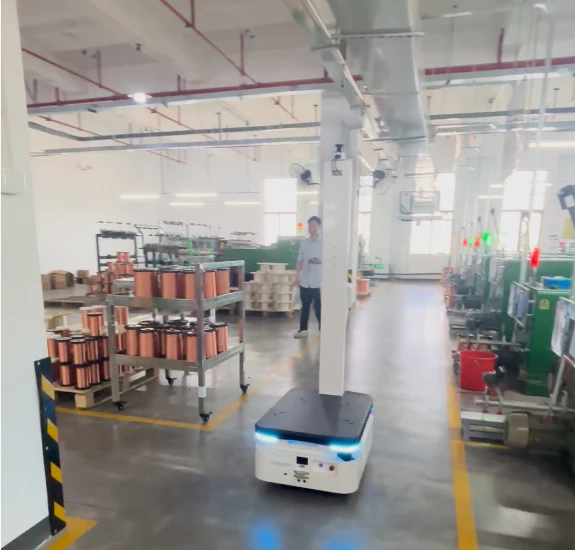
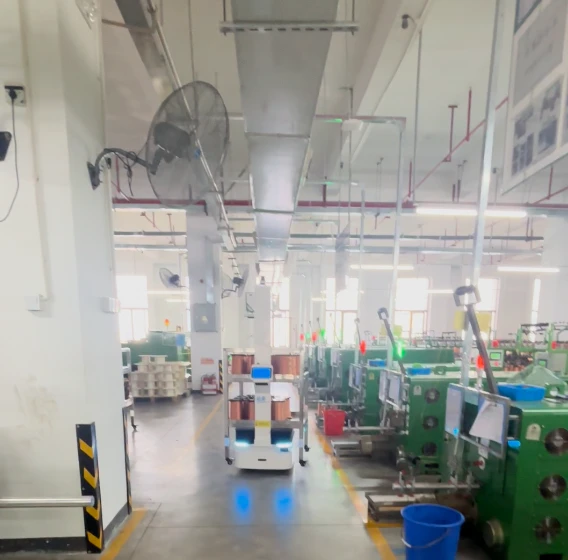
To address this challenge, a wire harness manufacturing factory in China has introduced the Reeman 300kg Fly Boat AMR with an automatic lifting system to support its internal material delivery operations.
The project demonstrates how autonomous mobile robots can connect different production workstations and make factory logistics more organized, flexible, and intelligent.
From Manual Cart Movement to Autonomous Material Transportation
In conventional wire harness workshops, material transportation is often organized around manual carts.
Although this method is simple, it creates several operational challenges:
Employees spend considerable time moving materials instead of focusing on production.
Material delivery depends heavily on worker availability.
Repetitive transportation increases physical workload.
Multiple carts moving through production areas can create congestion.
Coordinating material replenishment across different workstations can be difficult.
The Reeman Fly Boat AMR provides an alternative by automating the movement of compatible material racks.
With a maximum payload capacity of 300kg, the robot can transport production materials and semi-finished products between designated locations.
Its integrated lifting mechanism allows it to lift compatible racks from underneath, eliminating the need for workers to manually push loaded carts from one workstation to another.
Instead of relying entirely on manual transportation, the factory can introduce autonomous delivery into its existing production workflow.
How Does the AMR Work in a Wire Harness Factory?
The material transportation process can be organized into several simple stages.
1. Material Transportation Request
When a workstation requires additional materials or needs to transfer a material rack, an employee can initiate a transportation request through the designated one-click calling system.
2. Automatic Robot Dispatch
The Fly Boat receives the assigned task and navigates toward the designated pickup location.
3. Automatic Rack Pickup
After reaching the pickup position, the robot aligns with the compatible material rack and activates its lifting mechanism.
4. Autonomous Transportation
The robot carries the loaded rack along its configured route toward the target production workstation.
5. Material Delivery
Once it reaches the destination, the robot lowers the lifting platform and releases the rack at the designated position.
The AMR can then proceed to another assigned task or return to its standby location.
This workflow helps reduce unnecessary manual movement and provides a more consistent approach to internal material transportation.
Flexible Navigation for Changing Production Environments
Wire harness production facilities are often characterized by dense equipment layouts, multiple workstations, and frequently changing material requirements.
A fixed transportation route may not always be suitable for every production task.
The Reeman Fly Boat uses dual laser SLAM navigation to identify its surroundings, construct an environmental map, and navigate between predefined destinations.
Unlike traditional AGVs that depend on magnetic strips or QR-code markers, laser SLAM navigation does not require these physical floor guides.
This offers several advantages for existing manufacturing facilities:
Flexible route configuration according to factory requirements.
No magnetic tape installation along transportation paths.
Reduced dependence on fixed floor markers.
Autonomous navigation between multiple delivery points.
Better adaptability when transportation routes need to be adjusted.
For manufacturers planning to upgrade existing facilities, this approach provides an opportunity to introduce mobile automation without completely redesigning the production floor.
Supporting Lean Manufacturing and Just-in-Time Material Delivery
One of the major objectives of lean manufacturing is to ensure that materials arrive at the right workstation at the right time.
Unnecessary material accumulation, delayed replenishment, and excessive transportation activities can negatively affect production efficiency.
By introducing AMRs into internal logistics, manufacturers can gradually establish a more organized material delivery process.
For example, production teams can configure delivery points for raw material storage, wire processing, assembly, inspection, and finished product collection.
The robot can then transport compatible material racks between these locations according to the configured workflow.
This creates opportunities for more systematic material replenishment and supports the development of just-in-time production logistics.
Instead of having employees repeatedly travel between workstations to collect materials, workers can request transportation when needed.
Why Choose a 300kg Lifting AMR for Industrial Applications?
For manufacturing environments, selecting an AMR involves more than simply considering its payload capacity.
The robot must match the actual material handling requirements, including rack dimensions, lifting positions, transportation routes, and workstation configurations.
The Reeman Fly Boat offers several features for industrial material transportation:
300kg Payload Capacity
Suitable for transporting compatible production material racks and industrial goods weighing up to 300kg.
Automatic Lifting Mechanism
The approximately 10cm lifting height enables the robot to pick up and transport compatible racks without manual pushing.
One-Click Calling
Allows employees to request transportation through a designated calling interface.
Dual Laser SLAM Navigation
Supports autonomous navigation without requiring magnetic strips or QR-code floor markers.
Obstacle Detection
Uses LiDAR and additional sensors to detect obstacles and respond according to configured safety parameters.
Multiple Delivery Locations
Supports configured pickup and drop-off points for different factory transportation workflows.
A Practical Step Toward the Smart Factory
The application of the Reeman 300kg Fly Boat AMR in a Chinese wire harness factory reflects a growing trend in manufacturing: production automation is expanding beyond individual machines and into internal logistics.
While automated production equipment improves processing capabilities, autonomous mobile robots help connect different stages of the manufacturing process through intelligent material transportation.
By reducing repetitive manual handling and improving the organization of material movement, AMRs can become an important part of a modern factory logistics system.
For manufacturers looking to improve their existing facilities, starting with one or two clearly defined transportation processes can be a practical first step toward broader automation.
Reeman Robotics provides autonomous mobile robot solutions for industrial material handling, helping manufacturers build more flexible, connected, and efficient production environments.
Reeman Robotics – Let Robots Help Us Everywhere.