

Transforming Traditional Material Handling into Intelligent Factory Logistics
In modern wire harness manufacturing, efficient material transportation is essential for maintaining smooth production operations.
From wire cutting and stripping to crimping, assembly, quality inspection, and packaging, materials and semi-finished products must be transferred frequently between different production workstations.
In many traditional factories, these transportation tasks still depend on workers manually pushing material carts or handling heavy racks. This not only consumes valuable labor resources but can also interrupt production workflows when materials are not delivered on time.
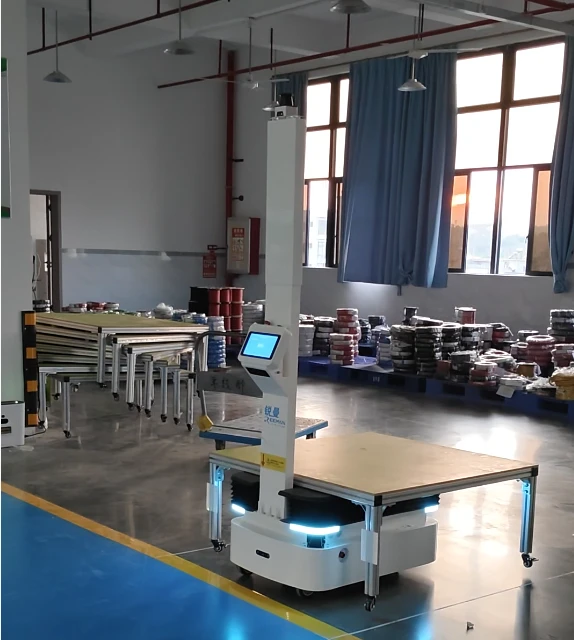
To improve internal logistics efficiency, a wire harness manufacturing factory in China introduced the Reeman 300kg Fly Boat Autonomous Mobile Robot (AMR) with an automatic lifting mechanism.
The solution enables autonomous material rack transportation between designated production stations, helping the factory move toward more flexible and intelligent in-plant logistics.
300kg Payload Capacity with Automatic Top Lifting
One of the key requirements in wire harness manufacturing is the frequent transportation of production materials and semi-finished products.
The Reeman Fly Boat AMR features a maximum payload capacity of 300kg and an integrated automatic lifting mechanism with a lifting height of approximately 10cm.
Instead of requiring workers to manually push heavy material carts, the robot can automatically approach a compatible material rack, lift it from the bottom, and transport it to the designated destination.
The automatic lifting function simplifies the material handling process by reducing manual loading and unloading operations.
Typical applications include:
Delivering raw materials from storage areas to production workstations.
Transporting wire harness components between processing stations.
Moving semi-finished products between assembly areas.
Replenishing production materials at designated workstations.
Transferring completed products to inspection and packaging areas.
With its compact mobile platform and lifting capability, Fly Boat provides a flexible solution for repetitive material transportation inside manufacturing facilities.
One-Click Calling: On-Demand Material Delivery
In traditional factory operations, workers may need to leave their workstations to find available material carts or arrange transportation whenever additional materials are required.
This creates unnecessary movement and reduces the time employees can spend on production activities.
The Reeman Fly Boat supports a one-click calling function, allowing employees to request material transportation through a designated call button.
Once a transportation request is received, the robot automatically navigates to the configured pickup location, performs the assigned material transportation task, and delivers the rack to the designated workstation.
The workflow is simple:
One-Click Call → Robot Dispatch → Automatic Navigation → Rack Pickup → Material Transportation → Delivery
This on-demand delivery approach makes material replenishment more convenient and helps production teams respond more efficiently to changing material requirements.
Multi-Point Delivery: Connecting Multiple Production Workstations
Wire harness manufacturing involves multiple production processes, and each workstation may require different materials at different times.
The Reeman Fly Boat supports multiple configurable delivery points, allowing factories to establish transportation connections between warehouses, production areas, assembly stations, and temporary storage locations.
For example, a transportation workflow can connect:
Raw Material Warehouse
Wire Cutting and Processing Area
Crimping Workstations
Assembly Production Lines
Quality Inspection Area
Finished Product Storage
Through predefined routes and task configurations, the robot can serve multiple destinations according to the factory's transportation requirements.
This provides manufacturers with a flexible way to organize internal logistics without requiring a separate transportation system for every workstation.
Dual Laser SLAM Navigation for Existing Factory Environments
One major challenge when introducing automation into an existing factory is adapting the robot to the current production layout.
Traditional AGV systems may require magnetic strips or QR-code markers installed on the factory floor, which can create additional preparation and maintenance work.
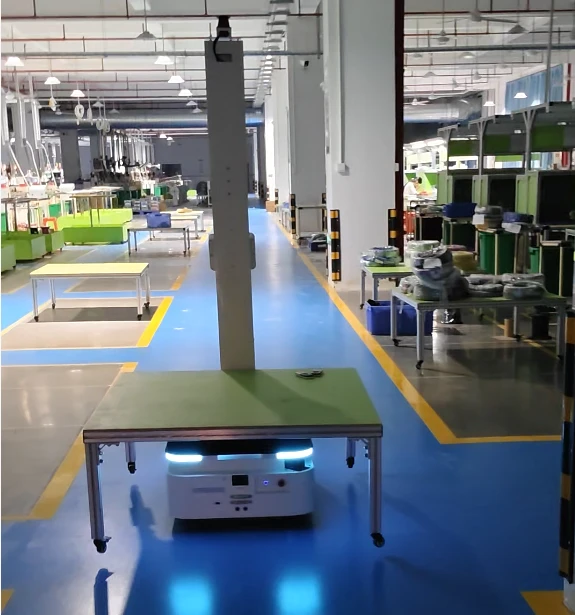
The Reeman Fly Boat uses dual laser SLAM navigation technology to map its working environment and navigate autonomously between configured destinations.
Key advantages include:
No magnetic strips or QR-code floor markers required.
Flexible transportation route configuration.
Autonomous navigation between multiple workstations.
Environmental perception and obstacle avoidance.
Adaptability to existing factory layouts.
The robot can operate along designated transportation routes while sharing the working environment with employees and production equipment.
This makes it a practical option for manufacturers looking to introduce automation without extensive modifications to their existing factory floors.
Intelligent Obstacle Avoidance for Safer Factory Operations
Manufacturing environments are constantly changing. Employees, material carts, equipment, and other vehicles may appear along transportation routes.
The Fly Boat combines dual laser LiDAR and multiple sensors to detect surrounding obstacles and respond according to its configured navigation and safety strategy.
When an obstacle is detected within its safety detection range, the robot can adjust its movement or stop as required.
This allows autonomous material transportation to be integrated into production environments where people and machines share operating areas.
Building a More Efficient In-Plant Logistics System
By introducing the Reeman 300kg Fly Boat AMR, the wire harness factory can automate repetitive material transportation tasks and establish a more organized internal logistics workflow.
The solution provides several potential operational benefits:
Reduced Manual Handling: Automates repetitive material rack transportation.
Improved Delivery Efficiency: Helps move materials between production stations more conveniently.
Less Unnecessary Walking: Allows employees to focus more on their production responsibilities.
Flexible Transportation: Supports multiple configured pickup and delivery locations.
Easy Factory Integration: Laser SLAM navigation reduces dependence on physical floor markers.
Scalable Automation: Provides a foundation for expanding AMR applications as production requirements grow.
Rather than replacing existing production equipment, the AMR works as a mobile logistics assistant that connects different manufacturing processes.