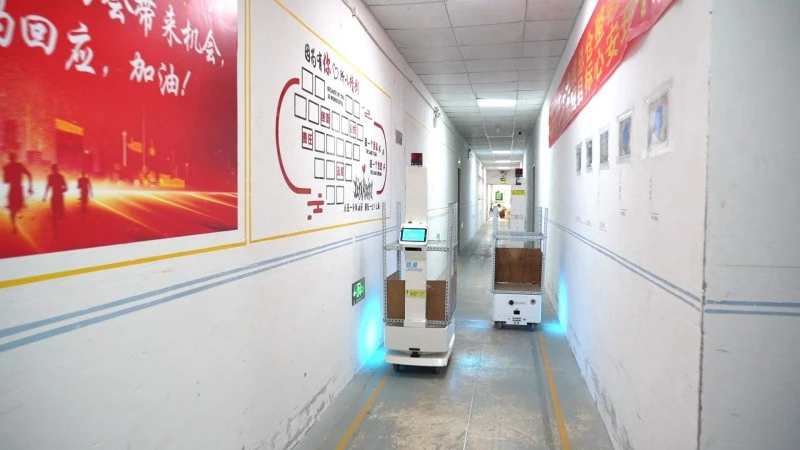
When people talk about automation in factories, they usually focus on labor savings or productivity. That wasn't the first thing this auto parts factory talked about. The discussion started withtraffic - not traffic outside the building, but traffic inside it. There was one aisle that connected several production areas, a storage zone, and the shipping section. During busy periods, forklifts, material carts, and employees all used the same route. Nothing unusual. Most factories have areas like that.
The problem was not that accidents happened every day. The problem was that everyone had to stay alert all the time. One supervisor put it this way. "You never knew exactly what would be coming around the corner." That comment ended up influencing more of the project than anyone expected. When the factory began testing Reeman Delivery Robots, the team spent less time discussing robot specifications than people might imagine. Most conversations were actually aboutmovement: Where should the robots travel? Which routes created unnecessary interaction with workers? What would happen during shift changes?
Some answers only became clear after the robots started operating on the factory floor. For example, one planned route looked efficient on a layout drawing. In practice, it crossed a pedestrian area that became crowded during lunch breaks. The route was changed after a few days. Another route was slightly longer than the original plan. The team kept it anyway because it reduced interactions between transport vehicles and workers. Small decisions like these had a bigger impact than expected.
The robots use LiDAR and onboard sensors to monitor their surroundings and respond to obstacles. That technology is important. But over time, the factory found that consistency mattered just as much. Workers gradually learned where the robots would appear, how fast they would travel, and how they would react when someone entered their path. After a while, the robots stopped feeling like new equipment. They became part of the normal rhythm of the factory. One employee joked that the robots were easier to predict than some forklift drivers. Nobody included that comment in the official project report, but people still remembered it.
Looking back, the most valuable outcome was not a specific feature or technical capability. It was the fact that movement inside the factory became easier to understand. When people know what to expect, they tend to work more comfortably and with fewer interruptions. That was a result the team appreciated more than they expected at the beginning of the project.