
From Manual Rack Transport to MES-Linked AMR Deliveries: A Three-Robot Garment Factory Case in Sri Lanka
A garment factory does not gain much from a mobile robot that can complete one demonstration route but cannot respond to real production demand. The important question is whether material requests from the factory's production system can become reliable, repeatable deliveries on the shop floor.
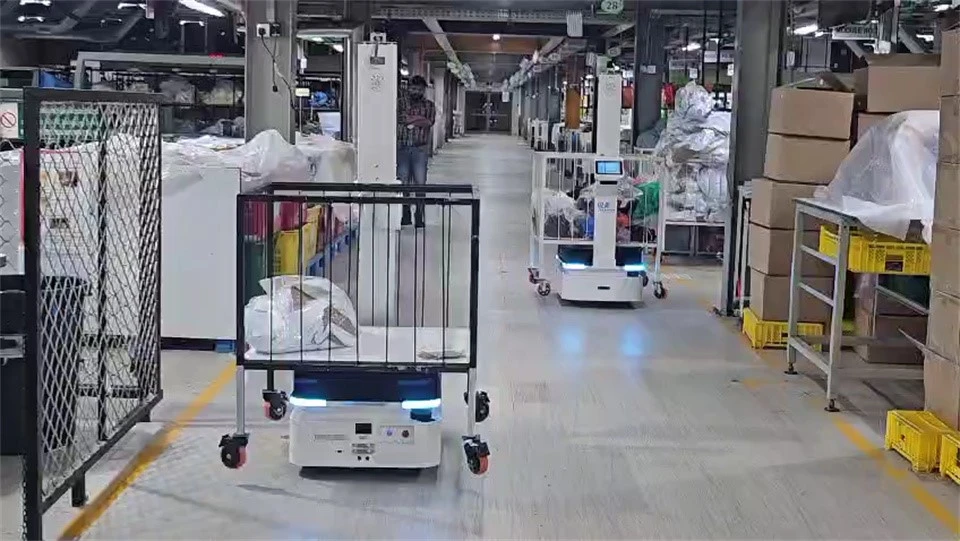
At a garment manufacturing facility in Sri Lanka, three REEMAN Dual Laser Fly Boat MAX lifting autonomous mobile robots (AMRs) have been deployed to transport racks carrying semi-finished garments. Their transportation tasks are coordinated by REEMAN's fleet scheduling system, which communicates with the customer's Manufacturing Execution System (MES) through an open API.
Previously, workers moved loaded racks manually. The automated workflow now connects an MES material request with robot pickup, 10 cm rack lifting, delivery to an assigned production workstation, and task completion feedback. The three-robot fleet is estimated to handle 200–250 point-to-point deliveries per day.
Coordinated fleet
Estimated daily deliveries
One-way task distances
Automatic rack lifting
Site Profile and Actual Operating Requirements
|
Industry / location |
Garment manufacturing / Sri Lanka |
|
Deployed solution |
3 REEMAN Dual Laser Fly Boat MAX lifting AMRs |
|
Material and carrier |
Semi-finished garments on wheeled racks |
|
Reported material load |
Approximately 50–100 kg per load |
|
Model rated payload |
Up to 300 kg |
|
Rack lifting height |
100 mm / 10 cm |
|
One-way delivery distance |
Approximately 150–300 m; task points vary by robot |
|
Daily delivery volume |
Estimated 200–250 trips across all 3 AMRs |
|
Systems integration |
MES → open API → REEMAN fleet scheduling |
|
Initial commissioning |
Approximately one week; primarily remote engineering support |
Project figures are approximate. The 50–100 kg figure describes the garments transported, whereas 300 kg is the model's rated payload. Rack self-weight must also be considered when assessing the complete lifted load.
The Factory Problem: Frequent Material Requests Across Different Workstations
The existing transport method relied on workers pushing garment racks from one production location to another. That created repetitive handling work whenever semi-finished garments needed to move between areas. Route lengths were not identical: individual one-way movements were reported at roughly 150–300 meters, and the three robots were assigned different task points.
From an engineering standpoint, automating this activity involved more than replacing manual pushing. The factory required the right rack to reach the right production point in response to an MES material request. A robot operating independently of production orders would leave the production and transportation workflows disconnected.
The chosen approach therefore combined under-rack lifting, autonomous navigation, fleet-level task assignment, and an interface to the existing MES.
The Integration Design: MES Manages Production; the AMR Fleet Executes Transport
The customer's MES remains responsible for production orders and material requirements. REEMAN's fleet scheduling system receives the transportation requests and arranges robot execution. The robots perform the physical material movement. Keeping these responsibilities separate is important: production software should not need to control the robot's individual navigation actions.
|
Factory MES |
Material request linked to production requirement |
|
Open API |
Pickup location + destination + work-order association |
|
REEMAN Fleet Scheduling System |
Transportation assignment and execution coordination |
|
Fly Boat MAX AMR |
Collect rack → lift 10 cm → deliver → lower rack |
|
Task Completion Feedback |
Result returned and associated with production request |
During integration, the team mapped production workstations, rack pickup positions, delivery destinations, task-trigger conditions, and associated work orders. When MES issues a delivery request, the interface converts it into a defined transport task. The fleet scheduling system arranges a robot to perform the job; after delivery, completion information is returned through the integration.
Engineering significance: this establishes an operational connection between production demand and material movement. It does not require a claim that the MES performs fleet traffic control or that the robot manages production orders; each system has a defined scope.
The On-Site Handling Process: Lift the Entire Wheeled Rack
The factory uses wheeled racks containing semi-finished garments. Rather than pushing the racks, the lifting-version Fly Boat MAX enters beneath a compatible rack, raises it by approximately 100 mm, and carries the complete unit to the assigned production workstation.
Pickup and 10 cm lifting
After receiving its assignment, the AMR travels to the specified pickup point. It positions itself beneath the rack and activates its lifting mechanism. The recorded video shows one robot reaching the task point and beginning rack transportation at approximately 00:16.
Delivery to the assigned production point
The robot carries the rack along the configured route, then lowers it at the destination. Different tasks can have different origins and endpoints, which is why the reported one-way route lengths vary from 150 to 300 meters.
Rack compatibility and load stability
Wheeled racks can be lifted when their underbody clearance, load-bearing structure and stability suit the AMR's lifting platform. The robot's 300 kg rated payload should not be confused with the 50–100 kg of garment material reported for this job: the complete rack and its contents are the relevant lifting load.
Three Robots on Different Tasks: What the Field Video Confirms
REEMAN's official deployment report identifies centralized task allocation, route coordination and traffic management as parts of the multi-robot project. The video provides a narrower but valuable form of evidence: it shows multiple AMRs undertaking transport movements within the same working factory.
Field video (YouTube):
Watch the real garment factory operation on YouTube
|
00:00 |
Three AMRs depart from the standby area. |
|
00:16 |
One robot reaches its pickup point, lifts a rack and sets off. |
|
00:40 |
Two robots encounter one another during operation. |
|
01:04 |
One robot arrives at an assigned task point. |
|
01:10 |
Another robot reaches its task point and departs. |
|
01:29 |
Robots return to standby for subsequent assignments. |
At 00:40, the footage shows two AMRs meeting in the factory. That is evidence of shared-space operation, but the clip alone does not establish which traffic-priority or collision-prevention rule was invoked. Likewise, returning to standby at 01:29 is not a filmed automatic charging event, although the deployed model supports automatic return to charging under its configured operating conditions.
Reported Results and the Limits of the Data
The strongest project-level operating figure currently available is an estimated 200–250 point-to-point deliveries per day across the three-robot fleet. The reported one-way route distances are approximately 150–300 meters, and the transported garment materials typically weigh 50–100 kg.
Operationally, the main change is that assigned rack movements no longer need to be performed by workers pushing materials between production points. MES-linked requests also allow delivery tasks to remain associated with production requirements rather than being managed as disconnected transport instructions.
These observations support a conclusion of reduced repetitive manual transportation and coordinated digital task execution. They do not, on their own, establish an audited labor reduction percentage, an exact productivity gain or an ROI figure. Those would require a measured pre-deployment baseline, task logs, robot operating hours and financial inputs.
Commissioning and Customer Feedback: A Successful Trial with Further Optimization Planned
The initial deployment took approximately one week. REEMAN's engineering team supported the project primarily remotely, working with the customer's local team on map construction, robot calibration, system configuration, scheduling adjustments and operational guidance.
After the trial, a customer project representative sent a written message thanking the REEMAN team for its technical expertise, proactive support, coordination and prompt responses. The message recognized the successful execution of the trial and expressed a desire to continue optimizing the system for greater operational efficiency.

Customer appreciation message following the successful AMR trial.
That distinction matters in a case study. A trial can validate an initial operating workflow without implying that every later optimization, throughput target or commissioning milestone has already been completed.
Engineering Takeaways for Other Apparel Manufacturers
Start with production-triggered transport requests
Map MES work orders and material requirements to specific pickup and delivery points before finalizing robot routes. Task triggering and completion feedback are part of the integration, not optional details.
Treat racks as part of the automation equipment
Check dimensions, clearance, lifting interfaces and rack-plus-garment load stability. A mobile robot cannot compensate for an incompatible carrier.
Size the fleet using real work, not rated payload alone
Fleet capacity depends on task frequency, travel distances, stop duration, route sharing, charging and daily operating hours. Three robots in one factory do not necessarily carry equal workloads.
Separate commissioning success from long-term optimization
Map validation, interface testing and successful initial deliveries demonstrate an operating foundation. Long-term performance should be reviewed against actual production logs and evolving material demand.
Frequently Asked Questions
Q1. What Materials Do The Three AMRs Carry In This Sri Lankan Factory?
A: They transport semi-finished garments using compatible wheeled material racks between assigned factory locations and production workstations.
Q2. How Does MES Integration Trigger Robot Deliveries?
A: The MES generates a material request, the open API transfers a corresponding pickup-and-destination task to REEMAN's scheduling system, and completion information is returned and associated with the production requirement.
Q3. How Many Deliveries Are Completed Per Day?
A: The current project estimate is approximately 200–250 point-to-point deliveries each day across all three robots combined, not per robot.
Q4. What Are The Actual Route Distances And Loads?
A: Reported one-way travel distances range from approximately 150 to 300 meters, while the garment materials typically weigh 50–100 kg per load.
Q5. Can The Robot Lift A Rack That Already Has Wheels?
A: Yes, if the rack has appropriate bottom clearance, support structure and stability. In this project, Fly Boat MAX enters beneath compatible wheeled racks and lifts them by approximately 10 cm.
Q6. Is The Actual 50–100 Kg Load The Robot's Maximum Capacity?
A: No. The Fly Boat MAX model is rated for up to 300 kg. The 50–100 kg range describes actual garment material loads in this factory; rack self-weight must also be included in the total load assessment.
Q7. How Are The Three AMRs Coordinated?
A: All three receive transport assignments through REEMAN's centralized scheduling platform. The official deployment report also describes route coordination and traffic management in the multi-robot implementation.
Q8. How Long Did The Initial Overseas Deployment Take?
A: Approximately one week, with engineering guidance provided primarily remotely alongside the customer's local team.
Q9. Did The Customer Confirm The Trial Was Successful?
A: A customer representative sent a written appreciation message acknowledging the team's contribution to successful trial execution and requesting continued support for further optimization.
Case Conclusion
This Sri Lankan garment factory illustrates what changes when AMRs are integrated into production logistics rather than demonstrated as isolated machines. Three REEMAN Fly Boat MAX units physically move compatible garment racks, while the fleet scheduling system handles transportation assignments initiated by the MES.
The estimated 200–250 daily deliveries, varied 150–300 m one-way routes and successful initial trial make this a useful reference for apparel manufacturers assessing MES-connected material handling. The customer's appreciation also highlights the importance of responsive engineering support during an overseas deployment.
Review the Fly Boat MAX factory delivery robot, including its 300 kg rated payload and autonomous factory transport applications.
Fly Boat MAX Product Details
REEMAN official project report (plain text): https://www.reemanrobot.com/news/reeman-dual-laser-fly-boat-max-successfully-de-85546472.html
Project References
- YouTube field video: https://youtu.be/y3C0jtkEIPg
- REEMAN Fly Boat MAX product information: https://www.reemanrobot.com/agv-amr/fly-boat-max-factory-delivery-robot.html
- REEMAN original deployment report: https://www.reemanrobot.com/news/reeman-dual-laser-fly-boat-max-successfully-de-85546472.html