

REEMAN Announces Upcoming Commercial Autonomous Tennis Ball Collector for Tennis Clubs and Academies
Coming Soon: A New Commercial-Grade Tennis Ball Collection Robot Built for Professional Facilities
REEMAN Robotics is preparing to introduce a commercial autonomous tennis ball collector designed specifically for professional tennis clubs, training academies, sports centers, and large-scale tennis facilities.
The upcoming robot represents REEMAN's planned expansion into sports facility automation, bringing its experience in autonomous mobile robots (AMRs), commercial cleaning robots, and industrial robotic platforms to a new application.
Unlike portable tennis ball collectors designed primarily for individual players, REEMAN's new concept focuses on commercial operations, where collection capacity, equipment durability, automated operation, and maintenance efficiency are essential.
The planned robot will prioritize high-capacity tennis ball collection, autonomous navigation, intelligent obstacle avoidance, and automatic recharging.
These capabilities are currently development objectives rather than confirmed production specifications.
REEMAN's vision is to transform tennis ball collection from a repetitive manual task into an automated facility operation.
1. Why Is REEMAN Developing a Commercial Tennis Ball Collector?
Across professional tennis academies and commercial tennis clubs, collecting tennis balls remains one of the most repetitive activities associated with daily training.
During multi-ball drills, coaches may use hundreds of tennis balls across multiple sessions.
Once a training session ends, balls are scattered around the court, including near baselines, sidelines, and perimeter fences.
Coaches, assistants, or other staff members must collect them before training can continue.
For individual players, this process may require only a few minutes.
For commercial facilities operating multiple courts throughout the day, however, these repeated collection tasks can add up to a considerable amount of manual work.
A facility operating ten courts may conduct dozens of training sessions daily, each requiring ball collection and preparation for the next group of players.
The resulting workload raises an important question:
Can autonomous robotics help tennis facilities spend less time collecting balls and more time supporting players?
REEMAN believes commercial tennis facilities represent a promising application for automated mobile robotics.
The company is developing a dedicated tennis ball collection concept with the aim of reducing repetitive manual work while supporting more efficient facility management.
2. Why Commercial Tennis Clubs Need More Than Portable Ball Collectors
Automatic tennis ball collection is already an emerging product category.
Existing solutions have demonstrated that robotics can assist individual players and coaches with collecting balls during practice.
However, equipment designed around personal training requirements is not necessarily optimized for continuous commercial use.
Personal tennis ball collectors generally place significant emphasis on portability, compact dimensions, storage convenience, and easy transportation.
These characteristics are valuable for individual users who need to carry their equipment between locations.
Commercial tennis facilities operate differently.
A professional tennis academy may have five, ten, or more courts, with training schedules extending across much of the day.
The facility operator is primarily concerned with whether the equipment can support frequent use, handle larger collection volumes, and remain practical to maintain.
For these customers, portability may be less important than operational reliability and automation.
A Different Approach to Product Development
REEMAN's upcoming commercial autonomous tennis ball collector is being planned around four essential principles:
First, capacity should match professional training requirements.
The equipment should be designed to collect larger quantities of tennis balls without requiring frequent interruption.
Second, autonomous operation should reduce manual supervision.
The robot should eventually be able to execute defined collection tasks using appropriate navigation and ball detection technologies.
Third, equipment design should support repeated commercial use.
A commercial robot must consider structural durability, service access, and operating conditions from the beginning of development.
Fourth, maintenance and charging should be convenient for facility staff.
Automatic recharging and accessible mechanical components could reduce routine equipment management work.
Rather than creating another portable personal training accessory, REEMAN intends to develop a robotic platform tailored to professional facility operations.
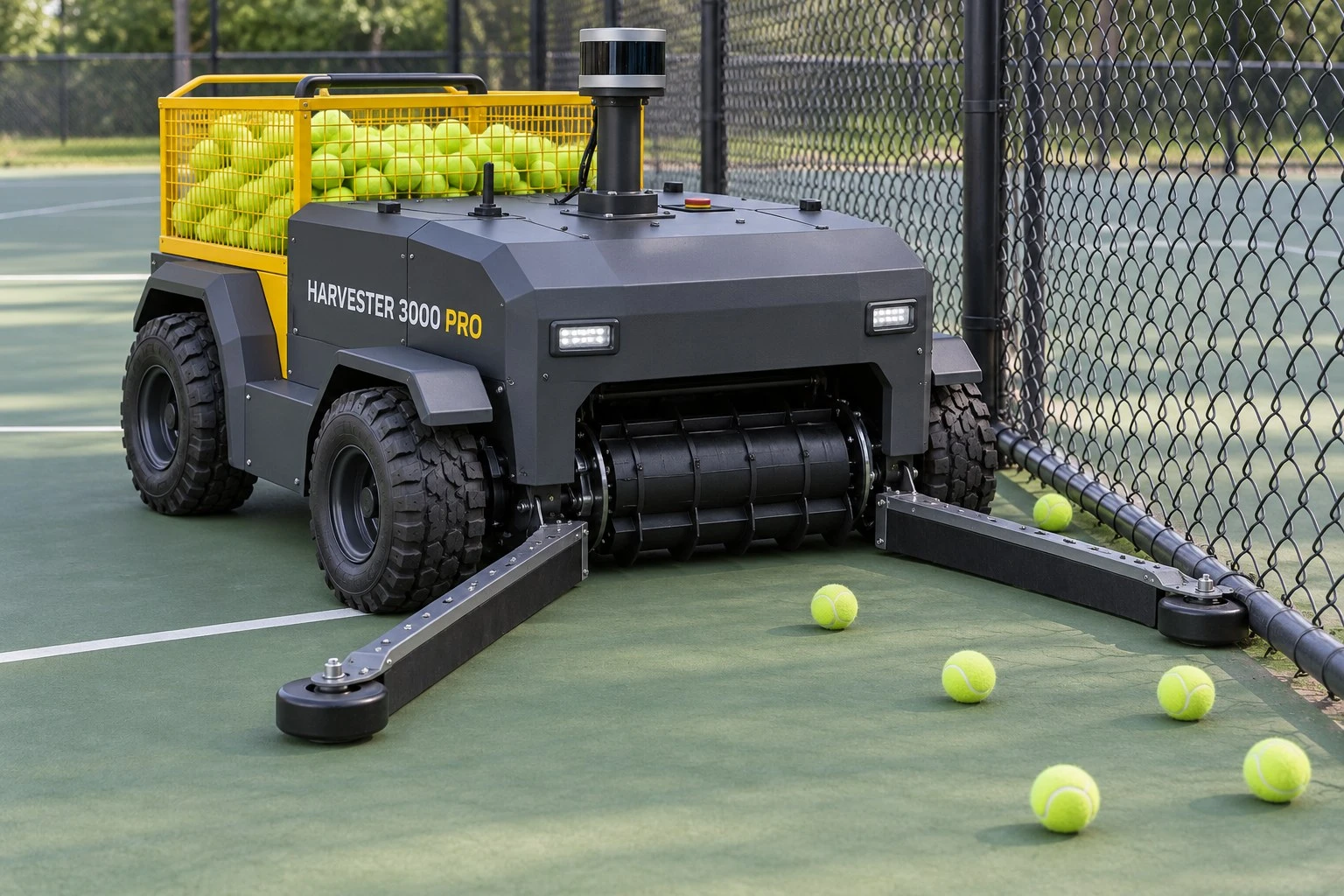
3. What Features Are Planned for the New REEMAN Tennis Ball Collection Robot?
The commercial autonomous tennis ball collector is currently being developed around several key engineering objectives.
High-Capacity Collection for Professional Training
REEMAN is exploring a collection basket with a target capacity of approximately 200–300 tennis balls.
This proposed capacity is intended to better support multi-ball training sessions and reduce the frequency of manual ball unloading.
The final capacity will depend on the mechanical design, robot dimensions, balance, and collection system performance.
It has not yet been confirmed as a final production specification.
Autonomous Navigation and Ball Detection
REEMAN plans to evaluate the integration of autonomous navigation and intelligent ball detection technologies.
The goal is to allow the robot to locate tennis balls, plan suitable collection routes, and coordinate movement with a dedicated pickup mechanism.
Engineering tests will need to address tennis balls positioned in different areas, including open court surfaces, sidelines, baselines, and areas near fencing.
The system will also need to consider obstacles, people, and existing court infrastructure.
Actual collection efficiency and supported operating conditions will be established through testing.
Commercial-Duty Mechanical Design
Unlike compact portable equipment, the planned REEMAN robot will prioritize stability and maintainability for professional use.
The development team intends to draw on REEMAN's existing commercial robot engineering experience when evaluating the chassis, drive system, sensor integration, and collection mechanism.
Special attention will be given to wheel design and contact with tennis court surfaces.
The objective is to develop an appropriate commercial platform without compromising the condition of supported court surfaces.
Automatic Recharging
REEMAN also plans to investigate an automatic charging solution.
Under the proposed operating concept, the robot could return to a designated charging location when a task is complete or when charging is required.
This would reduce manual charging operations and make the system more convenient for facilities that use the equipment regularly.
Automatic charging remains a planned capability requiring further development and validation.
Maintenance-Friendly Construction
Commercial equipment must be practical to inspect, clean, and maintain.
REEMAN intends to evaluate removable ball storage, accessible pickup components, and service-friendly equipment structures.
These considerations are important because commercial customers evaluate not only the initial purchase price but also the long-term cost of operating and maintaining equipment.
4. From Commercial Cleaning Robots to Tennis Court Automation
Why is a robotics manufacturer entering the tennis industry?
The answer lies in the similarities between commercial tennis ball collection and other repetitive tasks already addressed by autonomous mobile robots.
Founded in 2015, REEMAN Robotics develops robotic solutions for industrial logistics, autonomous transportation, commercial cleaning, and other automation applications.
Its existing engineering experience covers autonomous navigation, obstacle detection, mobile robotic platforms, automatic charging, and commercial equipment integration.
Many of these technologies provide relevant experience for developing a robotic tennis ball collector.
For example, commercial cleaning robots must navigate defined working environments, perform repetitive operations, and manage charging and maintenance requirements.
A tennis ball collection robot faces a different mechanical challenge, but the broader automation principles are similar.
Instead of collecting dust or debris, the new robot would be designed to identify and collect tennis balls.
The collection mechanism, ball detection system, and court-specific operating requirements will need dedicated engineering development.
However, REEMAN's background in mobile robotics offers a starting point for building a purpose-designed commercial solution.
The company's objective is not simply to make a tennis ball collector larger, but to apply commercial robotics engineering to a task that is still frequently performed by hand.
5. How Could Autonomous Tennis Ball Collection Change Daily Court Operations?
Consider a professional tennis academy operating several courts.
Throughout the day, different groups of players participate in individual lessons, group coaching, and intensive multi-ball training.
After each session, tennis balls must be collected and prepared for the next activity.
Today, this task may be performed by coaches, assistants, students, or facility maintenance staff.
REEMAN envisions a different workflow.
Once the relevant court is clear and suitable operating conditions are met, an authorized staff member could initiate a ball collection task.
The robot would then navigate the assigned area and collect scattered tennis balls.
After completing the task, staff could unload the collected balls and prepare the equipment for its next operation.
With a future validated automatic charging system, the robot could also return to its designated charging location when appropriate.
This operating concept is intended to reduce repetitive manual collection work and simplify routine facility management.
Potential Operational Benefits
For commercial tennis facilities, the potential value extends beyond the collection mechanism itself.
More Time for Coaching
Reducing manual ball collection could allow coaches and assistants to dedicate more attention to training and player development.
Improved Staff Allocation
Facility employees could spend less time performing repetitive collection tasks and more time supporting customers or maintaining other equipment.
More Consistent Court Preparation
A standardized collection process could make routine court preparation easier to organize.
Potential Improvements in Scheduling
If automated collection reduces the time or staff involvement required between sessions, operators may gain additional flexibility when managing training schedules.
These benefits represent intended outcomes. Actual performance and financial returns will need to be measured through commercial deployment and operating data.
6. Who Is the Upcoming REEMAN Tennis Ball Collector Designed For?
The new product is being developed primarily for business customers rather than the individual consumer market.
Tennis Academies
Professional training academies often require frequent collection of large quantities of balls.
A high-capacity autonomous collector could help reduce repetitive work during intensive training programs.
Commercial Tennis Clubs
Clubs with multiple courts must manage daily lessons, coaching activities, equipment preparation, and court maintenance.
An automated collection system could become a useful addition to regular facility operations.
Sports Training Centers
Large sports centers and dedicated tennis training facilities require equipment capable of supporting repeated tasks.
Commercial durability and maintenance efficiency are particularly important in these environments.
Luxury Resorts and Country Clubs
Premium resorts and country clubs may also benefit from automated equipment that helps staff manage recreational sports facilities.
Tennis Equipment Distributors and Robotics Partners
REEMAN is also interested in working with international distributors, sports equipment suppliers, and robotics integration partners serving professional facilities.
These partnerships could help connect the product with actual customer requirements in different regions.
7. Built for B2B: A Commercial Tennis Robotics Opportunity
REEMAN's market approach will focus on professional tennis facility operators and international B2B partnerships.
Instead of positioning the upcoming robot primarily as a consumer gadget, REEMAN intends to explore a commercial equipment model that addresses the operational priorities of facility owners.
For these customers, purchasing decisions are typically influenced by factors such as:
- Collection efficiency and usable capacity
- Reliability during repeated operation
- Equipment maintenance and service accessibility
- Staff training and operational simplicity
- Long-term ownership costs
- Availability of technical support
- Potential labor-time savings
A commercial tennis ball collector should ultimately be evaluated on its ability to improve these practical operating conditions.
Exploring Commercial Sales and Partnership Models
REEMAN plans to investigate several potential commercialization approaches, including direct B2B equipment sales and cooperation with overseas distributors.
Equipment leasing or service-based arrangements may also be evaluated according to market requirements.
These commercial approaches remain under consideration and are not yet confirmed sales programs.
The company welcomes early discussions with professional tennis facility operators and industry partners to better understand purchasing preferences and operational expectations.
8. What Will REEMAN Focus on Before the Official Product Launch?
The upcoming commercial autonomous tennis ball collector remains under development.
Before confirming commercial availability, several important areas will require engineering evaluation.
These include collection capacity, ball detection accuracy, mechanical pickup reliability, navigation performance, automatic charging, and compatibility with suitable tennis court surfaces.
Outdoor operating conditions and maintenance requirements will also be considered.
REEMAN intends to use these findings to further refine the proposed product design.
Final technical specifications, pricing, available configurations, and launch timing have not yet been announced.
The company will communicate additional details as product development progresses.
9. REEMAN Commercial Autonomous Tennis Ball Collector - Coming Soon
REEMAN Robotics is preparing to expand its commercial robotics portfolio with a new autonomous tennis ball collection solution.
The upcoming product is being designed with a clear market focus: professional tennis facilities that need practical equipment for recurring ball collection tasks.
By combining its engineering experience in autonomous mobile robots and commercial cleaning equipment with a dedicated tennis ball collection system, REEMAN aims to explore a new category of sports facility automation.
The company believes that commercial tennis facilities deserve automation solutions designed around their actual operating requirements.
Not just portable equipment.
Not simply a consumer training accessory.
But a purpose-built commercial robot intended to support the daily work of professional tennis facilities.
Less Time Collecting. More Time Coaching. Smarter Tennis Facility Operations.
Global Tennis Facility Operators and B2B Partners Welcome
REEMAN welcomes inquiries and early cooperation discussions from tennis academies, commercial clubs, sports facility operators, resorts, robotics distributors, and professional sports equipment suppliers.
If your organization operates multiple tennis courts or serves customers in the professional tennis industry, REEMAN would welcome the opportunity to learn about your collection requirements and automation needs.
REEMAN Commercial Autonomous Tennis Ball Collector - Coming Soon.
Learn more about REEMAN Robotics and its autonomous mobile robot solutions:
Frequently Asked Questions (FAQ)
Q: Is REEMAN developing a new commercial autonomous tennis ball collector?
A: Yes. REEMAN Robotics is developing a commercial autonomous tennis ball collector intended for professional tennis clubs, training academies, sports centers, and other commercial tennis facilities. The product has not yet been officially launched.
Q: What makes the upcoming REEMAN tennis ball collector commercial-grade?
A: The planned product focuses on commercial operating requirements, including higher collection capacity, autonomous operation, durable construction, automatic charging, and maintenance-friendly design. These objectives remain subject to development and validation.
Q: How many tennis balls will the new REEMAN robot collect?
A: REEMAN is evaluating a collection system targeting approximately 200–300 tennis balls. This is a preliminary design target, and the final capacity will be confirmed following engineering validation.
Q: Will the REEMAN tennis ball collector navigate automatically?
A: Autonomous navigation and intelligent ball collection are among the primary development objectives. The planned system will investigate navigation, ball detection, route planning, and mechanical pickup integration. Final performance specifications have not yet been confirmed.
Q: Will the robot support automatic charging?
A: Automatic recharging is included in the development plan. REEMAN aims to evaluate a system that allows the robot to return to a designated charging location with reduced manual intervention.
Q: Can the robot operate on outdoor tennis courts?
A: Outdoor tennis facilities are an intended application. Supported court surfaces, environmental protection, weather conditions, and operational restrictions will need to be established through product testing.
Q: Who should consider a commercial autonomous tennis ball collector?
A: Potential customers include professional tennis academies, commercial tennis clubs, sports training centers, resorts, country clubs, and organizations managing multiple tennis courts.
Q: How could the robot help tennis coaches?
A: A successfully deployed autonomous collector could reduce the amount of repetitive manual ball collection required during training operations, allowing coaches and assistants to dedicate more attention to players and instructional activities.
Q: Will REEMAN work with international distributors?
A: REEMAN welcomes early discussions with international robotics distributors, tennis equipment suppliers, and professional sports facility partners. Specific distribution and commercial arrangements will be determined as product development progresses.
Q: When will the REEMAN Commercial Autonomous Tennis Ball Collector be launched?
A: The product is currently under development, and an official launch date has not been announced. Final specifications, pricing, and commercial availability will be confirmed through future official communications.
Product Development Notice: The REEMAN Commercial Autonomous Tennis Ball Collector is an upcoming product concept under development. Planned features and performance targets are not confirmed production specifications.
About REEMAN Robotics
Founded in 2015, REEMAN Robotics develops autonomous mobile robots, commercial cleaning robots, industrial robotic platforms, autonomous forklifts, and intelligent service robot solutions.
REEMAN focuses on applying autonomous navigation and mobile robotics technologies to practical commercial and industrial applications.
Official Website: https://www.reemanrobot.com/
Related Reading and REEMAN Products
Explore the navigation background and existing commercial robotics experience relevant to this development direction.
- What are the advantages of laser navigation?
Background on mobile robot localization, mapping, and navigation without fixed floor tracks. - REEMAN Commercial Cleaning Robot Mop Sweeper Robot
An existing REEMAN commercial cleaning product with autonomous path planning and automatic return charging.
These references describe established navigation principles and existing products. The upcoming tennis ball collector requires its own collection mechanism, operating validation, and final product specifications.