

As warehouses continue to face increasing pressure to improve storage efficiency, reduce repetitive manual handling, and make better use of available space, autonomous forklift technology is becoming an important part of modern warehouse automation.
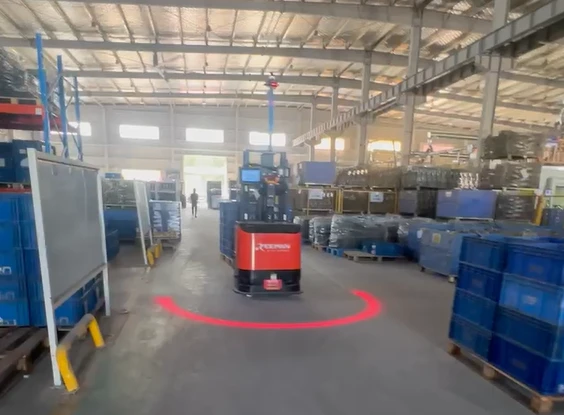
To address these challenges, Reeman Rhino Autonomous Stackerman provides an intelligent solution for pallet transportation and high-level stacking. With a 1.5-ton load capacity and 2.5-meter lifting height, Rhino is designed to handle heavy materials while automatically transporting and stacking pallets in warehouse environments.
By combining autonomous navigation, intelligent obstacle avoidance, pallet handling, and automatic charging, Rhino helps transform traditional forklift operations into a more consistent and automated material-flow process.
From Manual Forklift Operations to Autonomous Warehouse Handling
In a conventional warehouse, pallet handling often requires forklift operators to repeatedly perform the same tasks:
Pick up the pallet → Transport the pallet → Enter the storage area → Lift the pallet → Place it on the rack → Return for the next task
When these operations are performed throughout the day, warehouse operators need to continuously coordinate forklift movements, storage locations, traffic, and material priorities.
This becomes even more challenging when warehouses need to operate across multiple shifts or handle frequent inbound and outbound pallet movements.
Reeman Rhino is designed to automate these repetitive material-handling tasks.
Once the required routes and task points are configured, Rhino can autonomously travel between designated locations, pick up pallets, transport them to the assigned area, and perform high-level stacking operations.
This allows warehouse personnel to focus on higher-value activities while the robot handles repetitive transportation and stacking tasks.
1.5-Ton Load Capacity Meets Heavy-Duty Warehouse Requirements
The Rhino Autonomous Stackerman is built for industrial material handling, with a maximum load capacity of 1.5 tons.
This enables the robot to handle a wide range of palletized materials commonly found in manufacturing and logistics environments, including:
- Raw materials
- Finished products
- Industrial components
- Heavy packaging materials
- Production materials
- Standard warehouse pallets
The combination of a high load capacity and autonomous operation makes Rhino suitable for warehouses where materials need to be transported frequently between receiving areas, storage locations, production areas, and dispatch zones.
2.5-Meter Lifting Height: Making Better Use of Vertical Space
Warehouse floor space is expensive.
When pallets are stored only on the ground, a significant amount of vertical space can remain unused. Rhino addresses this challenge with a maximum lifting height of 2.5 meters, allowing pallets to be automatically placed onto higher storage positions.
This creates a typical automated warehouse workflow:
Pallet Receiving → Pallet Pickup → Autonomous Transportation → High-Level Stacking → Retrieval → Delivery
Instead of treating the warehouse floor as the only available storage area, businesses can make better use of vertical storage space.
Reeman's product information specifically positions Rhino as a high-stacking AGV for warehouses where vertical space optimization is important.
Laser SLAM Navigation Without Reflective Markers
One of the key technologies behind Rhino is Laser SLAM navigation.
Unlike traditional AGV systems that may require dedicated magnetic strips, QR codes, or reflective markers, Laser SLAM allows Rhino to navigate based on its perception of the surrounding environment.
This provides greater flexibility when deploying autonomous forklifts in existing warehouses.
The warehouse does not necessarily need to be completely rebuilt for robot deployment. After mapping and configuration, Rhino can autonomously navigate within its designated operating area.
This is particularly useful for warehouses with existing infrastructure where companies want to introduce automation without making major changes to the facility.
Reeman's Rhino specifications state that its Laser SLAM navigation does not require reflectors, while its latest RBOT30F product information also highlights marker-free navigation.

Intelligent Obstacle Avoidance for Dynamic Warehouse Environments
Warehouses are rarely completely static.
Workers, pallets, forklifts, carts, and other equipment may appear in the robot's operating area at different times.
For this reason, autonomous warehouse vehicles need more than route planning-they also need real-time environmental perception.
Rhino combines LiDAR and 3D vision technologies to detect obstacles and support autonomous avoidance and route adjustment.
When an obstacle appears along the planned route, the robot can respond according to the configured navigation strategy rather than simply stopping and waiting for manual intervention.
This helps Rhino operate more effectively in dynamic warehouse environments where human workers and autonomous equipment may share the same working area.
Automatic Pallet Transportation and High-Level Stacking
The major advantage of Rhino is that transportation and stacking are integrated into one autonomous workflow.
For example, a warehouse can configure Rhino to perform the following task:
Step 1 - Receive the task
The warehouse system assigns a pallet transportation or storage task.
Step 2 - Navigate to the pickup point
Rhino autonomously travels to the designated pallet location.
Step 3 - Pick up the pallet
The forklift aligns with the pallet and performs the loading operation.
Step 4 - Transport the pallet
Rhino autonomously travels to the assigned storage area.
Step 5 - Lift and stack
The forks lift the pallet to the required height and place it onto the designated storage position.
Step 6 - Return for the next task
After completing the operation, Rhino returns to the next task point or designated standby area.
This continuous workflow reduces the need for operators to manually drive the forklift between every individual operation.
Automatic Charging for Continuous Warehouse Operations
Warehouse automation does not stop simply because a robot needs to recharge.
Rhino supports automatic return-to-charging, allowing the robot to return to its charging station when charging is required.
After charging, it can resume its configured operating workflow.
This makes Rhino suitable for warehouses where material handling needs to continue across extended operating periods.
Instead of requiring warehouse staff to manually monitor the battery and move the forklift to a charging location, the charging process becomes part of the autonomous operating cycle.
Work → Low Battery → Return to Charger → Recharge → Resume Operation
A Practical Solution for High-Level Warehouse Storage
The Rhino Autonomous Stackerman is particularly suitable for warehouses where both heavy pallet handling and vertical storage are important.
Typical applications include:
-
Manufacturing Warehouses
Transport raw materials and finished products between production and storage areas while automating repetitive forklift operations.
-
High-Level Pallet Storage
Use the 2.5-meter lifting capability to place pallets onto higher storage positions and improve the utilization of vertical warehouse space.
-
Logistics Centers
Automate pallet transportation between receiving, storage, sorting, and dispatch areas.
-
Raw Material Warehouses
Handle heavy palletized materials while reducing repetitive manual transportation.
-
Finished-Goods Warehouses
Move finished products from production areas to designated storage locations or dispatch zones.
Reeman's published application scenarios for Rhino include high-rack warehouse stacking and retrieval, raw-material and finished-goods storage, manufacturing workshop parts stacking, and logistics-center pallet handling.
Designed for Integration with Smart Warehouse Systems
For customers looking to build a complete intelligent logistics system, the autonomous forklift should not operate as an isolated machine.
Rhino can be integrated into a broader warehouse automation architecture, including warehouse management and manufacturing systems.
The latest Rhino RBOT30F specifications identify open interfaces for integration with WMS and MES systems, enabling customers to connect autonomous forklift operations with their existing digital infrastructure.
This creates the possibility of coordinating:
WMS → Task Assignment → Rhino Autonomous Handling → Storage → Inventory Management
As a result, the forklift becomes part of the warehouse's overall digital material-flow system rather than simply replacing a manually operated forklift.
From "Forklift" to "Autonomous Warehouse Robot"
The biggest difference between a conventional forklift and an autonomous stacker is not simply whether a driver sits in the driver's seat.
It is whether the entire material-handling process can become automated, repeatable, and digitally managed.
With its 1.5-ton load capacity, 2.5-meter lifting height, Laser SLAM navigation, intelligent obstacle avoidance, autonomous pallet handling, and automatic charging, Reeman Rhino is designed to perform exactly these types of repetitive warehouse operations.
For warehouses looking to improve storage utilization while reducing dependence on repetitive manual forklift operations, Rhino provides a practical path toward autonomous material handling.
Reeman Rhino Autonomous Stackerman
- 1.5-ton load capacity
- 2.5-meter lifting height
- Laser SLAM autonomous navigation
- Intelligent obstacle avoidance
- Autonomous pallet transportation
- High-level pallet stacking
- Automatic return-to-charging
- WMS/MES integration capability
From pallet pickup to warehouse storage, Reeman Rhino brings autonomous intelligence to every movement.
Reeman Robot - Making Warehouse Material Handling Smarter, Safer, and More Autonomous.