
REEMAN Rhino Autonomous Forklift Integrates with Automatic Stretch Wrapping Machine for Smarter Pallet Handling
In modern manufacturing and warehousing, pallet handling and end-of-line packaging are essential operations. Although automatic stretch wrapping machines can efficiently secure palletized goods, the transportation of pallets to and from the wrapping station often still relies on manual forklift operation.
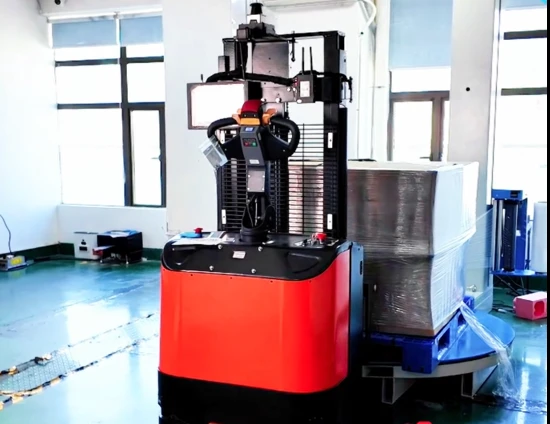
To connect these separate processes, REEMAN introduces an automated pallet handling solution featuring the Rhino Autonomous Forklift with a 1,500 kg load capacity, integrated with an automatic stretch wrapping machine.
By coordinating autonomous material transportation with automatic pallet wrapping, the solution helps manufacturers streamline their packaging workflow, reduce manual handling, and improve the consistency of internal logistics operations.
1. Rhino Autonomous Forklift: Designed for Heavy-Duty Pallet Handling
The REEMAN Rhino Autonomous Forklift is designed for industrial material handling, pallet transportation, and warehouse stacking applications.
With a rated load capacity of 1,500 kg and a maximum lifting height of 2.5 meters, Rhino can handle heavy palletized materials and transport them between production areas, packaging stations, and finished-goods warehouses.
Its autonomous navigation system allows it to follow predefined routes and reach designated workstations without requiring traditional floor-mounted guidance infrastructure.
Key Features:
- 1,500 kg Rated Load Capacity: Suitable for transporting heavy palletized goods.
- 2.5 m Maximum Lifting Height: Supports pallet handling and stacking operations.
- Laser SLAM Navigation: Enables autonomous navigation without magnetic strips or QR codes on the floor.
- Intelligent Obstacle Avoidance: Helps the forklift navigate shared factory and warehouse environments.
- Automatic Positioning: Supports accurate alignment with designated pallet pickup and unloading locations.
- Automated Charging: Allows the robot to return to its charging station according to its configured charging strategy.
2. How Does Rhino Work with an Automatic Stretch Wrapping Machine?
The key to this application is the coordination between the autonomous forklift and the automatic wrapping machine.
Instead of treating pallet transportation and stretch wrapping as two independent operations, REEMAN connects the equipment through a communication system, enabling them to exchange operating commands and status signals.
The complete workflow can be divided into the following steps.
Step 1: Automatic Pallet Pickup
Rhino receives a transport task and autonomously travels to the designated pickup location.
After aligning with the pallet, the forklift inserts its forks, lifts the pallet, and transports it toward the automatic stretch wrapping station.
Step 2: Precise Docking at the Wrapping Station
Upon reaching the wrapping station, Rhino positions the pallet at the designated transfer location.
The forklift lowers the pallet onto the wrapping machine's turntable, withdraws its forks, and moves clear of the rotating area.
Once the forklift has safely completed the handover, it sends a start signal to the wrapping machine through the communication module.
Step 3: Automatic Pallet Wrapping
After receiving the start signal, the wrapping machine begins its programmed packaging cycle.
The turntable rotates while stretch film is applied around the palletized goods. The wrapping machine completes the configured wrapping process and, where supported, automatically separates or cuts the film.
During this stage, Rhino remains outside the machine's operating area.
Step 4: Automatic Collection of the Wrapped Pallet
When the wrapping cycle is complete, the machine sends a completion signal to Rhino.
The autonomous forklift returns to the workstation, identifies the pallet position, aligns its forks, and picks up the wrapped goods.
Step 5: Transportation to the Next Destination
After collecting the finished pallet, Rhino transports it to the designated finished-goods warehouse, storage area, or downstream logistics station.
The wrapping and transportation processes are therefore connected into a coordinated workflow, reducing the need for operators to manually transfer pallets between machines.
3. Intelligent Communication Between Two Machines
A major advantage of this solution is that the autonomous forklift and wrapping machine can coordinate their operations through an external communication module.
Depending on the wrapping machine's controller and project requirements, the equipment-side connection can use:
- Digital I/O
- RS485
- Ethernet
- CAN
For wireless communication between the equipment and the autonomous forklift, LoRa or Wi-Fi can be selected according to the site conditions and system architecture.
The communication system allows the two machines to exchange essential commands and status information, such as:
Pallet delivery completed
Forklift has cleared the wrapping area
- Start wrapping
- Wrapping cycle completed
- Pallet ready for collection
The wrapping machine remains responsible for the wrapping operation, while Rhino handles pallet transportation and positioning.
This task-level coordination makes it possible to connect existing packaging equipment with autonomous material handling without necessarily replacing the original wrapping machine.
4. Benefits for Factory Packaging and Warehouse Logistics
Integrating the Rhino Autonomous Forklift with an automatic stretch wrapping machine can bring several practical benefits to manufacturing and warehousing operations.
- Reduced Manual Pallet Handling
Rhino takes over repetitive pallet transportation between designated locations, reducing the need for operators to drive a forklift for every transfer.
- Improved Packaging Workflow Coordination
Automatic communication between the forklift and wrapping machine helps connect pallet delivery, wrapping, and finished-pallet collection into a continuous process.
- More Consistent Material Transportation
Autonomous navigation and predefined docking positions support repeatable pallet transportation and handover operations.
- Better Utilization of Packaging Equipment
By coordinating pallet delivery and collection with the wrapping cycle, factories can reduce unnecessary waiting between material handling and packaging operations.
- Flexible Integration with Existing Equipment
Depending on the wrapping machine's controller interfaces and mechanical layout, the solution can be adapted to compatible existing packaging equipment.
5. Application Scenarios
The REEMAN Rhino Autonomous Forklift and automatic stretch wrapping machine integration is suitable for factories and warehouses that handle palletized materials and require automated end-of-line packaging.
Typical application industries include:
- Food and beverage manufacturing
- Electronics and electrical equipment manufacturing
- Chemical and industrial materials
- Consumer goods manufacturing
- Logistics and distribution centers
- General manufacturing and warehousing
Whether transporting raw materials, semi-finished products, or finished goods, Rhino helps connect pallet handling with downstream packaging and storage operations.
6. Build a Smarter Automated Packaging Workflow with REEMAN
Factory automation is not simply about introducing individual machines. It is about enabling different equipment to work together.
By integrating the REEMAN Rhino Autonomous Forklift with an automatic stretch wrapping machine, manufacturers can connect pallet transportation, machine-side packaging, and finished-goods delivery into a more coordinated logistics process.
With its 1,500 kg rated load capacity and 2.5 m lifting height, Rhino provides a practical solution for heavy-duty pallet handling and automated factory logistics.
Looking to automate pallet transportation and stretch wrapping in your factory?
Contact REEMAN to discuss your pallet dimensions, load weight, wrapping machine model, communication interfaces, and factory layout. Our team can help evaluate a suitable autonomous forklift integration solution for your application.