
Automating In-Plant Logistics for Smarter Pneumatic Component Manufacturing
In the manufacturing of pneumatic automation components, precision and efficiency are essential.
From pneumatic valves and cylinders to fittings, actuators, connectors, and other precision components, production often involves a large number of material transfers between warehouses, machining areas, assembly stations, inspection areas, and finished-goods storage.
When these materials are transported manually using carts or forklifts, internal logistics can become a hidden bottleneck.
To improve material flow and accelerate its smart manufacturing transformation, a leading pneumatic automation components manufacturer introduced the Reeman Dual Laser Fly Boat MAX AMR to automate internal material transportation.
With a 300 kg payload capacity and 10 cm automatic lifting height, the Fly Boat MAX provides a flexible solution for transporting material racks and carts between different areas of the factory.
The Challenge: Complex Material Flow Inside the Factory
A pneumatic component factory typically handles thousands of individual components throughout the production process.
Raw materials and components may need to move between:
Warehouse → Production Line → Assembly Station → Quality Inspection → Finished Goods Warehouse
As production volume increases, the number of transportation tasks increases accordingly.
The factory was facing several common logistics challenges:
- High dependence on manual material transportation
- Frequent movement of components and semi-finished products
- Long distances between warehouse and production areas
- Production waiting caused by delayed material delivery
- Increasing labor costs
- Heavy carts that are difficult for workers to move repeatedly
- Potential safety risks caused by mixed traffic between workers, forklifts, and carts
- Difficulty maintaining stable logistics efficiency during peak production periods
Traditional forklifts could handle heavy loads, but they were not always the most flexible solution for frequent point-to-point transportation inside production areas.
The factory therefore needed a more flexible and autonomous logistics solution.
The Solution: Reeman Dual Laser Fly Boat MAX
To address these challenges, the factory deployed the Reeman Dual Laser Fly Boat MAX for automated material handling.
The robot is designed specifically for factory environments where materials need to be transported frequently between multiple workstations.
Its core capabilities include:
-
300 KG Payload Capacity
The Fly Boat MAX can transport loads of up to 300 kg, making it suitable for production racks, material carts, components, semi-finished products, and finished goods.
For pneumatic component manufacturers, this provides sufficient capacity for transporting batches of components without requiring workers to manually push heavy carts.
-
10 CM Automatic Lifting
The integrated lifting mechanism allows the robot to automatically lift compatible racks and carts by up to 10 cm.
The transportation process becomes:
Arrive → Position → Lift → Transport → Lower → Release
This eliminates the need for workers to manually connect the cart to a tugger or physically push it from one workstation to another.
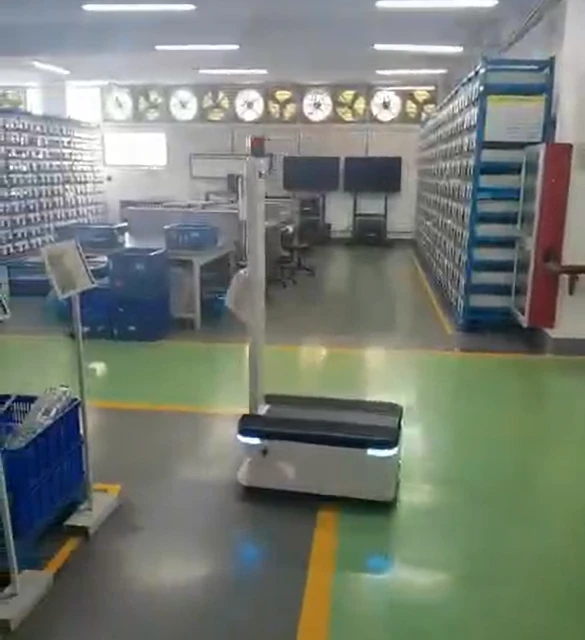
From Warehouse to Production Line: Fully Automated Material Flow
After deployment, the Fly Boat MAX can perform autonomous transportation missions throughout the factory.
Step 1: Material Preparation
Production materials are placed on standardized carts or racks in the warehouse or designated material area.
Once a transportation task is created, the AMR receives the destination information.
Step 2: Autonomous Pickup
The Fly Boat MAX navigates to the pickup station and accurately positions itself underneath the designated rack.
The robot then activates its lifting mechanism and raises the rack approximately 10 cm from the floor.
Step 3: Autonomous Transportation
After lifting the rack, the robot transports the materials to the assigned destination.
Instead of following a fixed magnetic path, the robot uses laser-based autonomous navigation to determine its route and navigate through the factory.
This makes it suitable for production environments where workers, carts, equipment, and other mobile objects may appear along the route.
Step 4: Delivery to the Workstation
When the robot arrives at the designated production or assembly station, it accurately positions itself and lowers the rack.
Workers can then directly access the required components.
Step 5: Continue to the Next Mission
After completing the delivery, the Fly Boat MAX can immediately receive another transportation task.
This creates a continuous material circulation system between the warehouse and production areas.
Dual Laser SLAM: Flexible Navigation Without Magnetic Tracks
One of the key advantages of the Fly Boat MAX is its autonomous navigation capability.
The robot uses Reeman's laser SLAM technology to build and navigate the factory environment without relying on traditional magnetic strips, QR codes, or physical navigation markers.
This provides several advantages for pneumatic component factories.
-
No Major Floor Modification
Factories do not need to install extensive magnetic tracks or navigation markers across production areas.
-
Flexible Route Planning
Transportation routes can be adjusted according to production requirements.
-
Better Adaptability
If production lines, workstations, or storage areas change, the logistics system can be adapted without rebuilding a fixed AGV infrastructure.
This flexibility is particularly valuable for manufacturers producing multiple product models or frequently adjusting production layouts.
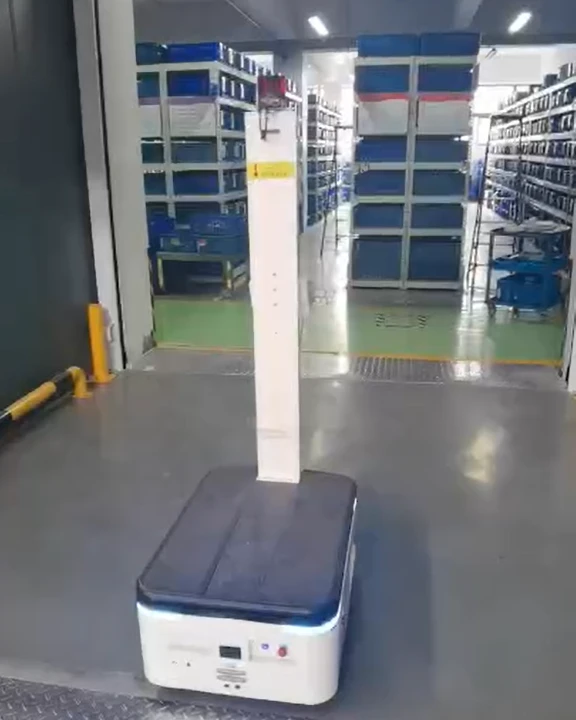
Intelligent Obstacle Avoidance for Dynamic Factory Environments
A pneumatic component factory is rarely static.
Workers move between workstations. Forklifts transport materials. Carts may temporarily occupy aisles. Production equipment can also change the available space.
The Fly Boat MAX combines laser sensing, 3D vision, and other safety sensors to perceive its surrounding environment and respond to unexpected obstacles.
When an obstacle is detected, the robot can slow down, stop, or adjust its route according to the operating conditions.
This allows AMRs and human workers to share the same production environment while reducing the need for dedicated robot-only transportation lanes.
From Manual Handling to Autonomous Logistics
Before automation, material transportation required workers to repeatedly:
Push → Wait → Load → Transport → Unload → Return
With the Fly Boat MAX, the workflow becomes:
Call → Pickup → Transport → Delivery → Next Task
This changes the role of factory employees.
Instead of spending significant time performing repetitive transportation tasks, workers can focus more on:
- Assembly
- Production operations
- Quality inspection
- Machine operation
- Material preparation
- Process management
The robot handles the repetitive movement while people focus on higher-value production activities.
Intelligent Scheduling for Multiple AMRs
As the factory's automation requirements grow, one AMR does not have to operate alone.
The Fly Boat MAX supports multi-robot scheduling, allowing multiple robots to share transportation tasks across the factory.
The system can coordinate:
- Robot task assignment
- Transportation priorities
- Route planning
- Delivery points
- Traffic management
- Charging requirements
This means the factory can start with a small number of robots and gradually expand the AMR fleet as production demand increases.
Automatic Charging for Continuous Operation
Internal logistics does not stop simply because a robot's battery is low.
The Fly Boat MAX supports automatic charging. When its battery reaches a predefined threshold, the robot can autonomously return to its charging station.
After charging, it can resume transportation tasks.
This reduces manual intervention and helps maintain continuous factory logistics operations.
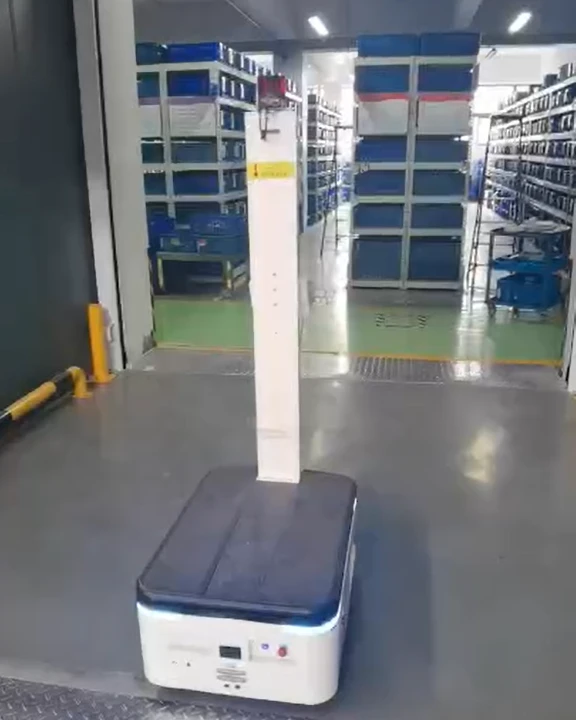
Connecting AMR Logistics with the Smart Factory
For modern pneumatic component manufacturers, AMRs are not only transportation equipment.
They can also become part of the factory's digital logistics infrastructure.
The Fly Boat MAX supports API integration and can be connected with systems such as:
WMS → MES → ERP → PLC → AMR
For example, when a production line requires a specific batch of components, the system can generate a transportation task and assign it to an available AMR.
The robot then automatically:
Receives the task → Goes to the pickup area → Picks up the material rack → Delivers it to production → Completes the task
This creates a more connected and data-driven internal logistics workflow.
Key Benefits for the Pneumatic Components Factory
The deployment of the Reeman Dual Laser Fly Boat MAX helps address several important logistics challenges.
-
Reduced Manual Transportation
Repetitive material transportation can be transferred from workers to autonomous robots.
-
Faster Material Delivery
Automated transportation helps reduce waiting time between production and material supply.
-
More Accurate Logistics
Predefined pickup and delivery points help standardize the material flow.
-
Improved Workplace Safety
The reduction of manual heavy-cart handling and better coordination between robots and people can improve the factory working environment.
-
Flexible Production Layout
Laser SLAM navigation allows the logistics system to adapt to changing factory layouts.
-
Scalable Automation
The factory can gradually increase the number of AMRs as production requirements grow.
A Smarter Way to Move Pneumatic Components
In a pneumatic automation components factory, every component matters-but so does every movement between production processes.
A delayed material delivery can interrupt an assembly station. A missing component can slow down an entire production line. Repetitive manual transportation can also consume valuable labor resources.
The Reeman Dual Laser Fly Boat MAX provides a smarter alternative.
With a 300 kg payload capacity, 10 cm automatic lifting, autonomous laser navigation, intelligent obstacle avoidance, automatic charging, and multi-robot scheduling, it transforms traditional material transportation into an autonomous logistics process.
Instead of workers constantly moving materials around the factory, the robot takes responsibility for the repetitive transportation work.
- Less manual handling.
- Less waiting.
- More flexible logistics.
- More intelligent manufacturing.
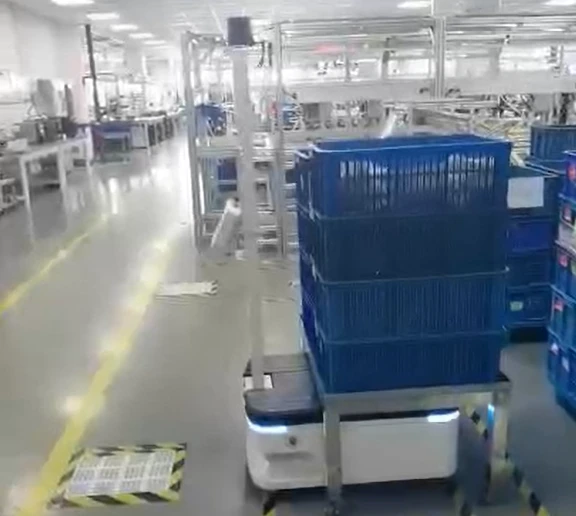
Reeman Dual Laser Fly Boat MAX
300 KG Payload | 10 CM Lifting | Dual Laser SLAM | Autonomous Material Handling | Smart Factory Logistics
Reeman is helping pneumatic component manufacturers move from traditional material handling toward a more flexible, connected, and intelligent factory.