

The global stock of operational robots is projected to reach around 3.9 million units in 2024, setting a new record. This growing demand is driven by a variety of exciting technological innovations. The International Federation of Robotics (IFR) has recently highlighted five major automation trends for 2024:

Artificial Intelligence and Machine Learning
The use of Artificial Intelligence (AI) in robotics and automation is a rapidly expanding trend. Generative AI, a subset of AI, is opening new possibilities by creating solutions based on learned data, and has become popular through tools like ChatGPT. Robotics manufacturers are now developing AI-powered interfaces that enable users to program robots using natural language instead of code, making the process more intuitive and accessible. Workers will no longer need specialized programming skills to adjust robot actions.
Another significant example is predictive AI, which analyzes robot performance data to anticipate equipment maintenance needs. Predictive maintenance can save manufacturers significant costs by preventing unplanned machine downtime. In the automotive parts industry, unplanned stoppages can cost as much as $130 million per hour, showcasing the immense potential for cost savings.
Machine learning algorithms are also optimizing robot performance by analyzing data from multiple machines performing the same tasks. The more data these algorithms receive, the better their performance becomes.
Collaborative Robots Expanding to New Applications
Human-robot collaboration remains one of the key trends in robotics technology. Advancements in sensors, vision technologies, and intelligent grippers allow robots to respond in real-time to environmental changes, making it safe to work alongside human operators. Collaborative robots (cobots) lighten the workload for human workers by assisting with tasks that involve heavy lifting, repetitive movements, or hazardous environments.
A notable market development is the increasing use of cobots in welding applications, driven by a shortage of skilled welders. This indicates that automation is not causing labor shortages but rather addressing them. Cobots are expected to complement, rather than replace, traditional industrial robots, which are much faster and crucial for increasing productivity in cost-sensitive industries.
New players are also entering the collaborative robotics market, with mobile manipulators-a combination of collaborative robotic arms and autonomous mobile robots (AMRs)-offering new use cases and significantly expanding demand.
Mobile Manipulators
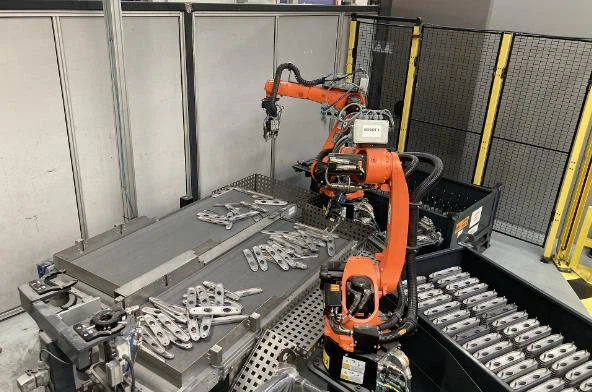
Mobile manipulators are automating material handling tasks across industries such as automotive, logistics, and aerospace. These robots combine the mobility of robotic platforms with the dexterity of robotic arms, enabling them to navigate complex environments and manipulate objects. This capability is vital for applications in manufacturing. Equipped with sensors and cameras, mobile manipulators are increasingly used for inspection and maintenance tasks on machinery and equipment.
One of the standout advantages of mobile manipulators is their ability to collaborate with and support human workers. The shortage of skilled labor and lack of interest in factory jobs may further drive demand for these robots.

Digital Twins
The use of digital twins is becoming more prevalent as a tool to optimize the performance of physical systems by creating virtual replicas. As robotics become more digitally integrated within factories, digital twins can use real-world operational data to simulate and predict potential outcomes.
Since digital twin robots are purely computer models, they can be stress-tested and modified without safety concerns, offering cost savings. All experiments can be verified before impacting the physical world, bridging the gap between the digital and physical realms.
Humanoid Robots
Robotics technology is seeing significant advancements in humanoid robots designed to perform a wide range of tasks across various environments. With two arms and two legs, humanoid robots can operate in work environments designed for humans, allowing for easy integration into existing warehouse processes and infrastructure.
China's Ministry of Industry and Information Technology recently set a target to begin mass production of humanoid robots by 2025. Humanoid robots are expected to become a disruptive technology, much like computers or smartphones, potentially transforming the way we produce goods and live.
While the potential impact of humanoid robots across industries is enormous, their large-scale market adoption remains a complex challenge. Cost will be a critical factor, and the success of humanoid robots will depend on their return on investment, especially when compared to more established solutions like mobile manipulators.

Marina Bill, President of the International Federation of Robotics, noted, "These five interconnected automation trends for 2024 illustrate how robotics is a multidisciplinary field where various technologies are converging to create intelligent solutions for a wide range of tasks. These advancements continue to shape both the industrial and service robotics sectors, along with the future of work."
Please click on the link below to read more:
Introducing Iron OX: The Future Of Autonomous Material Handling
Introducing The Reeman Moon Knight Robot Chassis
Introducing The Flash Food Delivery Robot
Would you like to know more about robots:https://www.reemanrobot.com/
robot mop,mopping robot,vacuum cleaner robot,clean robot,commercial cleaning robot,floor cleaning,sweeper robot,robots cleaning,vacuum robot,cleaning robot,wet and dry robot vacuum cleaner,commercial mopping robot,sweeping robot ,uv-c robot vacuum cleaner,floor cleaning robot,robot cleaner,floor mopping machine,robot mop cleaner,vacuum cleaner,robot vacuum mop,vacuum cleaning robot,mop robot,robot cleaner vacuum,cleaner mop robot,uvc robot cleaning,cleaning robots smart vacuum,cleaning robot commercial,intelligent cleaning robot,commercial mop robot