

In large warehouse environments, material handling is often a high-frequency and labor-intensive process. As storage areas expand and order volumes increase, traditional manual forklift operations struggle to maintain consistent speed, safety, and accuracy. To solve this challenge, autonomous forklifts are increasingly being deployed to handle internal logistics in a more intelligent way.
In a typical large warehouse, autonomous forklifts are responsible for transporting pallets across different functional zones, including inbound receiving areas, storage racks, sorting zones, and outbound shipping docks. Once connected to the warehouse management system (WMS), the forklifts can automatically receive transport tasks and execute them without manual driving.
Unlike traditional forklifts, autonomous models rely on laser SLAM navigation, real-time mapping, and multi-sensor perception to operate safely in complex environments. They can accurately locate themselves within large indoor spaces and dynamically adjust routes when encountering obstacles such as workers, other vehicles, or temporary storage changes.

One of the key advantages of autonomous forklifts is their ability to operate continuously without fatigue, enabling 24/7 warehouse operations. This is especially valuable in industries such as e-commerce, manufacturing, and third-party logistics, where high throughput and fast response times are critical.
In addition, automation significantly reduces dependency on skilled forklift operators, lowers training costs, and minimizes human error in pallet handling. It also improves workplace safety by reducing the risk of collisions and operational accidents in busy warehouse corridors.
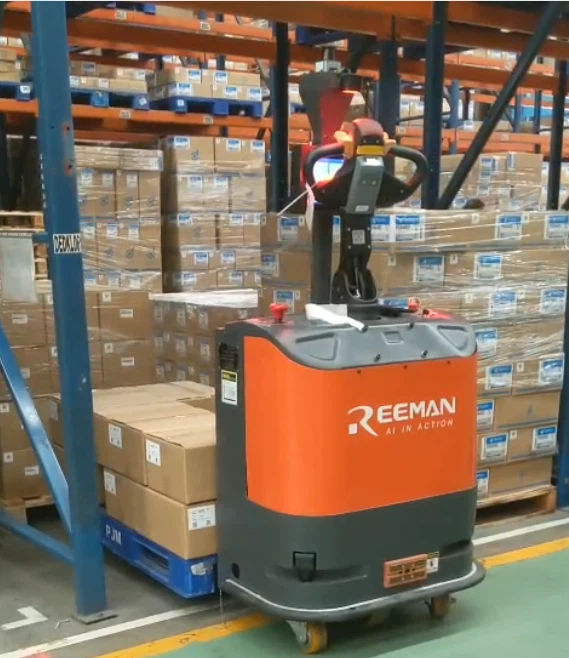
Overall, autonomous forklifts are becoming an essential part of modern smart warehouses, helping companies achieve higher efficiency, more stable operations, and fully digitalized material flow management.