

Introduction: Accelerating Automation in Factory Logistics
Material handling has always been a time-consuming and labor-intensive task in factories. In the past, many companies relied on manual trolleys or forklifts, which were not only inefficient but also prone to errors. Now, more and more factories are using AMR (Autonomous Mobile Robot) delivery robots, making material handling faster, more accurate, and reducing labor costs. In this article, we'll explore 10 real-world case studies to see how these robots are changing factory logistics.
Healthcare and Biotechnology: Efficient Delivery, Saving Time and Effort
1.Shanghai Philips Medical: Automating Medical Equipment Transport
At Shanghai Philips Medical, AMR robots handle the transport of medical equipment on the production line. Previously, manual carts were used, making a maximum of 10 trips per hour. After implementing robots, efficiency improved by 45%, and the robots' contactless, contamination-free handling meets the high standards required in the healthcare industry.

2.Yahui Long Biotech: More Accurate Reagent Transport
Yahui Long Biotech uses AMR robots to deliver biological samples and reagents in its lab. The robots autonomously navigate, and path planning only takes 10 seconds. They can also avoid obstacles flexibly. Compared to manual handling, delivery efficiency has increased by 30%, and the error rate is nearly zero, ensuring the safety of biological samples.

Footwear and Electronics Manufacturing: Smoother Production Lines
3.Xingang Footwear: Automated Handling of Finished Shoes
Xingang Footwear has deployed AMR robots on its production line to transport finished shoes to the inspection area. The robots operate 24/7 and can automatically recognize product labels, ensuring accurate delivery. Since the implementation, the factory's shipment efficiency has increased by 35%, with almost no errors in handling.

4.Adidas Head Footwear Factory: Intelligent Warehouse Logistics
A major Adidas footwear factory has also introduced AMR robots to automatically move finished shoes from the production line to the warehouse. The robots can interface with conveyors, accurately placing items in designated storage locations. After the upgrade, warehouse efficiency improved by 40%, and labor costs were reduced by 60%.

Manufacturing Industry: Faster Handling and Fewer Errors
5.Quan Zheng Guo Dian Electronics Factory: Efficient Electronic Component Delivery
Quan Zheng Guo Dian Electronics uses AMR robots to transport electronic components. The robots autonomously navigate and complete deliveries within 15 minutes, 50% faster than manual handling. This automated system reduces human error and increases production line efficiency.

6.Rihui Da: Automating Automotive Parts Warehouse Handling
Rihui Da's automotive parts logistics warehouse also uses AMR robots. The robots automatically identify storage locations and transport various items, from screws to larger components. Efficiency increased by 40%, and the error rate dropped to just 0.2%, requiring minimal human intervention.

7.A Certain Automotive Parts Factory Warehouse: More Efficient High-Frequency Deliveries
After introducing AMR robots, a certain automotive parts factory now only requires one robot to handle tasks that previously needed five workers. The robot autonomously schedules its routes, making 15-18 trips per hour and boosting efficiency by 60%.

Light Industry and Overseas Manufacturing: Saving Labor and Increasing Efficiency
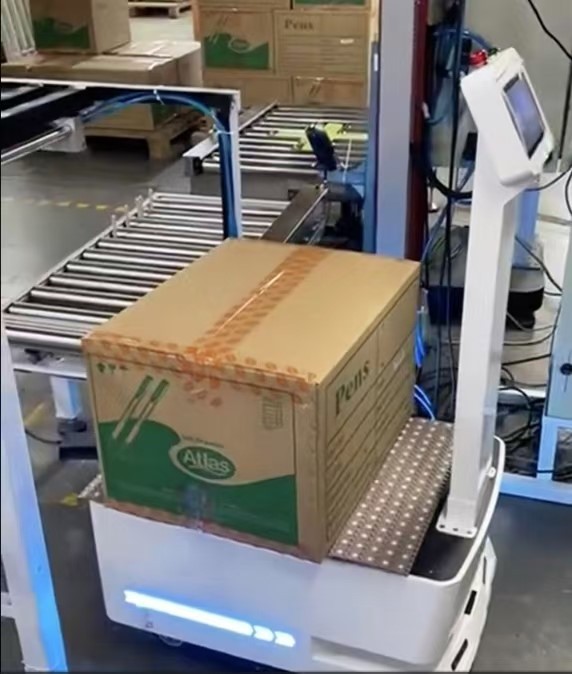
8.Indian Pen Factory: Automated Handling of Finished Pens
A large pen factory in India uses AMR robots to transport finished pens. The robots travel back and forth in narrow aisles without the risk of errors or losing products, unlike manual handling. Efficiency increased by 50%, and material loss significantly decreased.
9.Tape Manufacturer: Faster Material Flow
A tape manufacturer uses AMR robots to transport finished rolls of tape. Whereas manual handling took 30 minutes per batch, robots complete the task in just 12 minutes, improving efficiency by 60%. The reduced waiting time on the production line also accelerates shipment speed.

10.LCD Screen Factory: Precise Delivery of Sensitive Materials
An LCD screen factory uses AMR robots to transport fragile LCD screen components. With precise navigation, the robots ensure smooth transportation, preventing damage to the screens. Since adopting the robots, the screen breakage rate has decreased by 40%, significantly reducing factory losses.

Conclusion: AMR Robots Make Factory Logistics More Efficient
These 10 case studies demonstrate the impressive performance of AMR delivery robots in factories:
Higher Efficiency: Compared to manual labor, robot handling efficiency has generally improved by 30%-60%.
Labor Cost Savings: Many factories have reduced labor costs by 40%-60% thanks to the use of robots.
Precision and Stability: Robots autonomously avoid obstacles and precisely position items, reducing material damage by 20%-40%.
Flexible Scheduling: AMR robots can work continuously for 24 hours without rest, ensuring stable and efficient material handling.
In the future, as robot technology continues to evolve, factory logistics will become even more automated, with higher efficiency and lower costs. AMR robots are playing a crucial role in driving this transformation.