
Inside an Indonesian Food Plant: How REEMAN Ironhide Moves 1.29-Ton Dough Containers
Customer Application | Food Manufacturing | Customized Load Handling | ROS 2
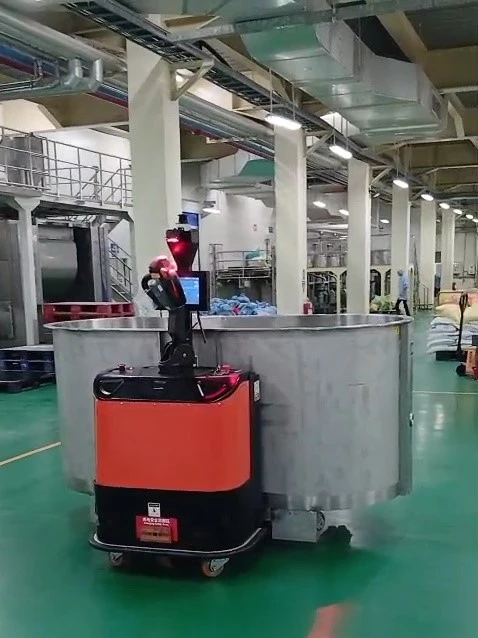
A large metal dough container is not a standard pallet. Yet at a major food and beverage producer in Indonesia, a REEMAN Ironhide autonomous forklift moves these containers as part of the plant's daily internal logistics. Each loaded movement involves approximately 800 kg of dough plus a 490 kg container-a combined 1,290 kg. The site reports a transport distance of about 200 meters per trip and 70–90 trips per day.
Watch the customer footage: https://youtube.com/shorts/wU8LhAwDMsk
A production task built around existing equipment
The customer operates in packaged foods, snacks, biscuits, chocolate, dairy drinks, cheese and other beverages. Its dough-handling workflow relies on large metal vessels fitted with caster wheels. Repeatedly moving these heavy carriers between production areas creates a clear opportunity to evaluate autonomous transport, but their undersides differ from those of ordinary pallets.
Rather than describing this as a standard pallet pickup, the case centers on the practical interface between the vehicle and a purpose-adapted production container.
At a glance
|
Dough per loaded trip |
Approximately 800 kg |
|
Empty metal container |
Approximately 490 kg |
|
Combined transported weight |
Approximately 1,290 kg (1.29 metric tons) |
|
Reported trip distance |
Approximately 200 m |
|
Reported daily frequency |
70–90 trips |
|
Robot task system |
ROS 2-based single-robot dispatch |
|
Carrier |
Modified metal container originally fitted with caster wheels |
The engineering detail: modifying the wheeled container
The customer adapted the container's underside for the handling arrangement. The work involved the caster-wheel region, metal plates over wheel-related areas and two openings, and a crossbeam welded across the central underside. These are site-specific modifications-not a universal design that can be copied without engineering checks.
For similar projects, engineers need to review the carrier's geometry, structural strength, center of gravity, ground clearance, load distribution and the robot-to-carrier interface. The visible footage confirms the container moving with the forklift, but does not establish every mechanical detail of the engagement.
What the operation shows
The short customer video shows the Ironhide moving a substantial metal container through an active production environment with equipment and personnel nearby. Project information separately reports approximately 200 meters per transport trip and 70–90 daily trips. The video itself is not a complete recording of the 200-meter route or a full day's activity.
At the reported frequency, 70–90 trips of 200 meters represent approximately 14–18 km of cumulative task distance daily, excluding any additional travel not captured by the stated trip length. If every trip carries the full 800 kg dough load, the corresponding theoretical handled quantity is 56–72 metric tons of dough per day. Neither calculation should be mistaken for independently verified daily output.
Why ROS 2 matters here
This installation uses a ROS 2-based single-robot dispatch system. ROS 2 provides a modular robotics software framework, with DDS-based communication, configurable quality-of-service policies and managed node lifecycles. Those capabilities can help developers organize sensing, localization, planning and control software. They are architectural features, not evidence that this site achieved a specific latency reduction or uptime improvement. The reported setup is single-robot dispatch, not a confirmed multi-robot fleet.
Operational value and a responsible ROI discussion
The business case rests on repeatability: a heavy, specialized carrier is moved many times each day. Potential benefits include reducing manual vehicle-operation time, organizing recurring transport tasks and retaining existing production vessels through suitable modifications. Quantified labor savings, production gains and payback have not been supplied by the customer.
For an illustrative workload comparison only, if a manual trip took eight operator-minutes and the plant operated 26 days monthly, 70–90 trips per day would represent about 243–312 operator-hours of baseline transport activity each month. This is an assumption-based example, not measured savings. A meaningful payback estimate requires total equipment and integration cost, actual recoverable labor hours, maintenance, energy and ongoing software costs.
Questions food manufacturers commonly ask
Q: What does the robot transport in this Indonesian facility?
A: A modified wheeled metal container holding approximately 800 kg of dough. With the 490 kg container included, the reported combined weight is about 1,290 kg.
Q: How often does it run?
A: Project data indicates approximately 70–90 transport trips per day, each around 200 meters.
Q: Can autonomous forklifts work with wheeled vessels rather than pallets?
A: They can in suitably engineered applications. This customer modified the container underside with metal plates and a welded central crossbeam to fit the site's handling arrangement.
Q: Does the short video prove the daily transport figures?
A: No. It shows a real movement sequence; trip distance and daily frequency come from project operating information.
Q: What dispatch software is used?
A: A ROS 2-based single-robot dispatch system. No multi-robot fleet deployment has been confirmed for this case.
Q: How quickly will the project pay for itself?
A: The actual payback period is not available. It depends on the total project investment, labor hours that can truly be recovered and incremental operating costs.
Q: Could a similar solution be used in another food factory?
A: Possibly, after evaluating container design, loaded weight, transport path, floor conditions, clearances and integration requirements.
A useful reference beyond pallet automation
This Indonesian deployment illustrates an important distinction: adapting the load carrier can be just as significant as selecting the robot. With approximately 1.29 tons moved per loaded trip and a reported 70–90 daily tasks, the case offers a concrete reference for food manufacturers exploring repetitive transport of non-standard production vessels.
Explore the related product: REEMAN Ironhide 3.0 Autonomous Forklift
Note: The customer application is identified as REEMAN Ironhide; the precise on-site hardware revision has not been independently confirmed as 3.0.