
REEMAN Rhino Stacker Deployed in Dongguan Shoe Factory for Automated Cross-Floor Pallet Transport
A real-world footwear manufacturing case covering elevator integration, production-to-warehouse delivery, narrow-aisle engineering and rack stacking.
INDUSTRY
Footwear Manufacturing
LOCATION
Dongguan, Guangdong, China
SOLUTION
REEMAN Rhino Stacker Autonomous Forklift
APPLICATION
Cross-Floor Pallet Transport & Warehouse Stacking
Project Background: Moving Shoe Products Between Production and Storage Floors
At a footwear manufacturing factory in Dongguan, China, moving finished shoe products from the production line to the warehouse is an essential part of daily operations.
The production area is located on the third floor, while the warehouse is on the fourth floor. Every transport task requires collecting palletized goods, traveling between floors via elevator and delivering them to a designated storage location.
Each pallet weighs approximately 600 kg, and the factory requires 65–80 complete round-trip transportation tasks per day. A full route covers approximately 500 meters.
A comparable manually operated forklift task was estimated to take around 30 minutes, involving repeated travel between production and warehouse areas.
To reduce dependence on manual transportation, the factory deployed a REEMAN Rhino Stacker Autonomous Forklift, integrated with the existing elevator control system and a One-Touch Remote Call button.
The objective was to establish a reliable, repeatable material transportation workflow within the factory's existing infrastructure.
The Implemented Solution: One Forklift Connecting Two Floors
The deployment connects the third-floor production area and fourth-floor warehouse through an automated transport sequence.
The Rhino Stacker begins at the fourth-floor warehouse. Once a transport request is triggered through the remote calling button, the forklift navigates toward the elevator.
Through its integrated elevator control interface, the forklift requests elevator access, enters the elevator and travels to the third floor.
After reaching the production line, it approaches the designated pickup location and collects the pallet carrying approximately 600 kg of shoe products.
The forklift then returns to the elevator, travels back to the fourth floor and delivers the goods to the assigned warehouse position.
The elevator measures approximately 3 m wide and 2.5 m deep, accommodating the deployed forklift configuration.
This workflow connects remote task activation, autonomous navigation, elevator communication and pallet handling without requiring a driver to accompany each transport task
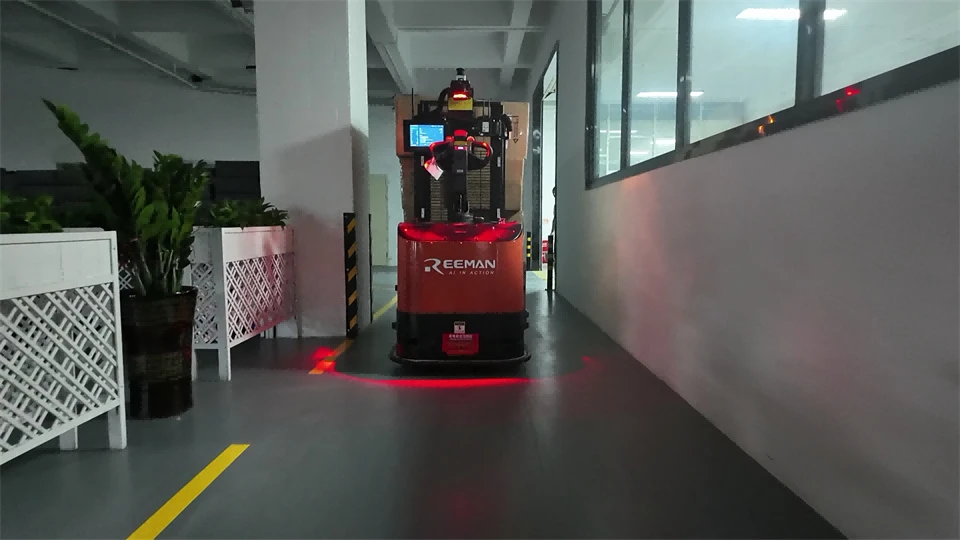
Real Factory Video: From One-Touch Calling to Warehouse Delivery
The following video documents the actual deployment at the Dongguan footwear manufacturing factory.
Watch the real deployment
Video Chapters
|
00:00 |
Receives a remote call and departs from the fourth-floor warehouse |
|
00:09 |
Enters the elevator and travels to the third floor |
|
00:38 |
Travels to the third-floor production line |
|
01:15 |
Automatically picks up the shoe products for delivery |
|
02:01 |
Takes the elevator back to the fourth-floor warehouse |
|
03:15 |
Arrives at the designated storage location and unloads the goods |
The footage captures elevator integration, autonomous pallet pickup and delivery between floors.
On-Site Engineering: Adapting to a 2.6 m Narrow Aisle
One of the most significant challenges during deployment was the available clearance for double-sided pallet handling.
While general transportation aisles measure approximately 4 meters wide, the narrowest handling area is only 2.6 meters.
For this particular double-sided pallet handling maneuver, the Rhino Stacker's standard recommended aisle width is approximately 2.7 meters. The difference required an engineering assessment of the existing operating space.
REEMAN engineers adjusted the sensitivity of the 3D obstacle detection system for the designated handling area. The forklift is also equipped with a front safety bumper.
Because adjustments to obstacle detection can affect protective performance, such configurations require site-specific safety validation, suitable speed restrictions and personnel protection measures. A front bumper cannot replace appropriate non-contact safeguarding.
The 2.6-meter handling arrangement represents a project-specific configuration rather than a standard operating clearance applicable to every installation.
For facilities with limited warehouse space, this deployment illustrates why actual aisle dimensions, pallet geometry, turning clearance and safety requirements must be evaluated together before commissioning autonomous equipment.
Additional Application: Second-Level Warehouse Rack Stacking
The factory's material handling requirements extend beyond transportation between floors.
Some goods need to be placed on second-level warehouse racks at approximately 2 meters above floor level.
The Rhino Stacker has a rated load capacity of 1,500 kg and a maximum lifting height of 2.5 meters.
In this application, the actual transported loads are approximately 600 kg per pallet. The customer also uses the forklift for second-level rack placement.
Although the published video focuses on cross-floor transportation and unloading, elevated rack stacking forms part of the customer's warehouse application.
This allows the same autonomous forklift platform to support both horizontal material movement and elevated pallet storage, subject to load-center limits and rack compatibility.
Deployment Overview and Operating Data
|
PARAMETER |
FACTORY APPLICATION |
|
Customer Industry |
Footwear Manufacturing |
|
Location |
Dongguan, Guangdong, China |
|
Robot Model |
REEMAN Rhino Stacker |
|
Actual Pallet Load |
Approximately 600 kg |
|
Rated Load Capacity |
1,500 kg |
|
Maximum Lifting Height |
2.5 m |
|
Transport Route |
4F Warehouse → 3F Production → 4F Warehouse |
|
Complete Round-Trip Distance |
Approximately 500 m |
|
Daily Transportation Requirement |
65–80 complete round trips |
|
General Aisle Width |
Approximately 4 m |
|
Narrowest Double-Sided Handling Aisle |
2.6 m; site-specific configuration |
|
Configured Travel Speed |
0.8 m/s |
|
Elevator Dimensions |
3 m wide × 2.5 m deep |
|
Warehouse Rack Placement |
Approximately 2 m |
|
Task Activation |
One-Touch Remote Call |
|
Cross-Floor Integration |
Automatic elevator control |
Based on the daily transportation requirement, completing all scheduled tasks represents approximately 32.5–40 kilometers of route travel per day.
The forklift's configured travel speed is 0.8 m/s, adjustable within the equipment's operating limits and site safety requirements.
The factory has also reported an estimated autonomous task time of approximately 10 minutes. However, the complete cycle time requires further verification because traveling 500 meters at 0.8 m/s alone takes approximately 10.4 minutes, before accounting for elevator waiting, pallet pickup and unloading.
For this reason, the daily transportation requirement and demonstrated cross-floor workflow provide the most meaningful operational references from the project.
Customer Value: A Repeatable Production-to-Warehouse Workflow
The main value of this deployment is the integration of autonomous material handling into an existing multi-story factory.
The Rhino Stacker connects production and storage areas through a defined transportation process, reducing the need for a driver to perform every repeated cross-floor delivery.
The project delivers several practical operational capabilities:
- Automated cross-floor delivery: The forklift works with the elevator control system to move materials between the third and fourth floors.
- Flexible task initiation: Operators can initiate transportation requests through a One-Touch Remote Call button.
- Autonomous pallet handling: Approximately 600 kg loads are collected from production and delivered to the designated warehouse area.
- Adaptation to existing layouts: The narrow handling area was addressed through project-specific engineering adjustments.
- Warehouse stacking capability: The forklift also supports second-level rack placement at approximately 2 meters.
These capabilities help establish a more consistent material handling process while reducing repetitive operator involvement.
The deployment also provides a practical reference for factories considering automation without completely redesigning their production and warehouse layouts.
Frequently Asked Questions
Q1: What Problem Did The Autonomous Forklift Solve At This Shoe Factory?
A: The factory needed to automate repetitive transportation of palletized shoe products between its third-floor production line and fourth-floor warehouse. The Rhino Stacker connects the two floors through automatic elevator integration and autonomous pallet handling.
Q2: How Many Transport Tasks Are Required Each Day?
A: The factory requires approximately 65–80 complete round-trip transportation tasks daily. Each route covers approximately 500 meters and involves moving goods between the production floor and warehouse.
Q3: Can The Rhino Stacker Automatically Operate An Elevator?
A: Yes. When integrated with a compatible elevator control system, the forklift can request elevator access and travel between designated floors. This function is demonstrated in the Dongguan factory deployment video.
Q4: Can The Forklift Handle A 2.6-Meter-Wide Aisle?
A: At this factory, the narrowest double-sided pallet handling area measures 2.6 meters. The installation required site-specific 3D obstacle detection adjustments and appropriate safety validation. The standard recommended width for this maneuver is approximately 2.7 meters.
Q5: Can The Rhino Stacker Transport And Stack Pallets?
A: Yes. The forklift has a rated load capacity of 1,500 kg and a maximum lifting height of 2.5 meters. At this factory, it transports approximately 600 kg loads and is also used for second-level rack placement at around 2 meters.
Q6: What Should Manufacturers Consider Before Deploying A Similar System?
A: Important factors include pallet dimensions and weight, elevator compatibility, aisle clearance, rack height, daily transport frequency, pedestrian safety and the integration requirements of the existing facility.
Conclusion: A Practical Example of Multi-Floor Factory Automation
The Dongguan footwear manufacturing project demonstrates how an autonomous stacker forklift can be integrated into an existing factory to support repetitive production-to-warehouse transportation.
Rather than relying solely on equipment specifications, the deployment addresses real operating requirements: cross-floor transportation, elevator communication, constrained pallet handling space and elevated warehouse storage.
For footwear manufacturers and other multi-story industrial facilities, the project provides a practical reference for evaluating autonomous forklift deployment based on actual material flow, site conditions and operational requirements.
REEMAN Rhino Stacker Product Details