
How REEMAN Ironhide Autonomous Forklift Automates 160–200 Pallet Trips/Day with One-Touch Calling
At a new-energy manufacturing plant in Huzhou, Zhejiang, China, the REEMAN Ironhide Autonomous Forklift is used for high-frequency point-to-point pallet transport. The configured route is approximately 47 meters, the actual transported load is about 1.5 tons, and the forklift completes approximately 160–200 transport tasks per day. Employees start the workflow through a one-touch remote call button, but the button does more than summon the forklift: it activates a complete task configured during deployment, including travel to the pickup point, pallet recognition, automatic fork alignment, pickup, point-to-point transport, pallet placement, fork withdrawal, subsequent assigned tasks and automatic return to charging. The wireless call supports up to 100 meters without requiring factory-wide network coverage. Using an equipment reference price of approximately US$9,900 and a representative overseas labor-cost model, the estimated equipment-cost payback is approximately 2.6 months, with 2–4 months as a practical initial planning range for comparable high-utilization applications.
Real Factory Case at a Glance
|
Parameter |
Case Data |
Operational Meaning |
|
Location |
Huzhou, Zhejiang, China |
Real customer deployment |
|
Industry |
New-energy manufacturing |
Internal production logistics |
|
Autonomous Forklift |
REEMAN Ironhide |
Automated pallet handling |
|
Actual Transported Load |
Approx. 1.5 tons |
Real application load |
|
Configured Route |
Approx. 47 m |
Pickup-to-delivery task route |
|
Daily Task Volume |
Approx. 160–200 trips |
High-frequency repetitive logistics |
|
Assigned Transport Distance/Day |
Approx. 7.5–9.4 km |
Excludes extra return and repositioning travel |
|
Task Start |
One-touch remote call |
Employee initiates the predefined workflow |
|
Call Communication Range |
Up to 100 m |
Call-signal range, not transport limit |
|
Factory-Wide Network Coverage |
Not required for call function |
Reduces network dependency |
|
Consecutive Tasks |
Continue when another task is assigned |
Supports continuous operation |
|
Idle State |
Automatic return to charging |
Closes the operating loop |
|
Equipment Reference Price |
Approx. US$9,900 |
Ironhide + one-touch call button |
|
Estimated Equipment Payback |
Approx. 2–4 months |
Base-case model: approx. 2.6 months |
| Distance note: The 7.5–9.4 km/day figure is calculated from the approximately 47 m route multiplied by 160–200 tasks. It excludes empty return travel, repositioning and other movements. | ||
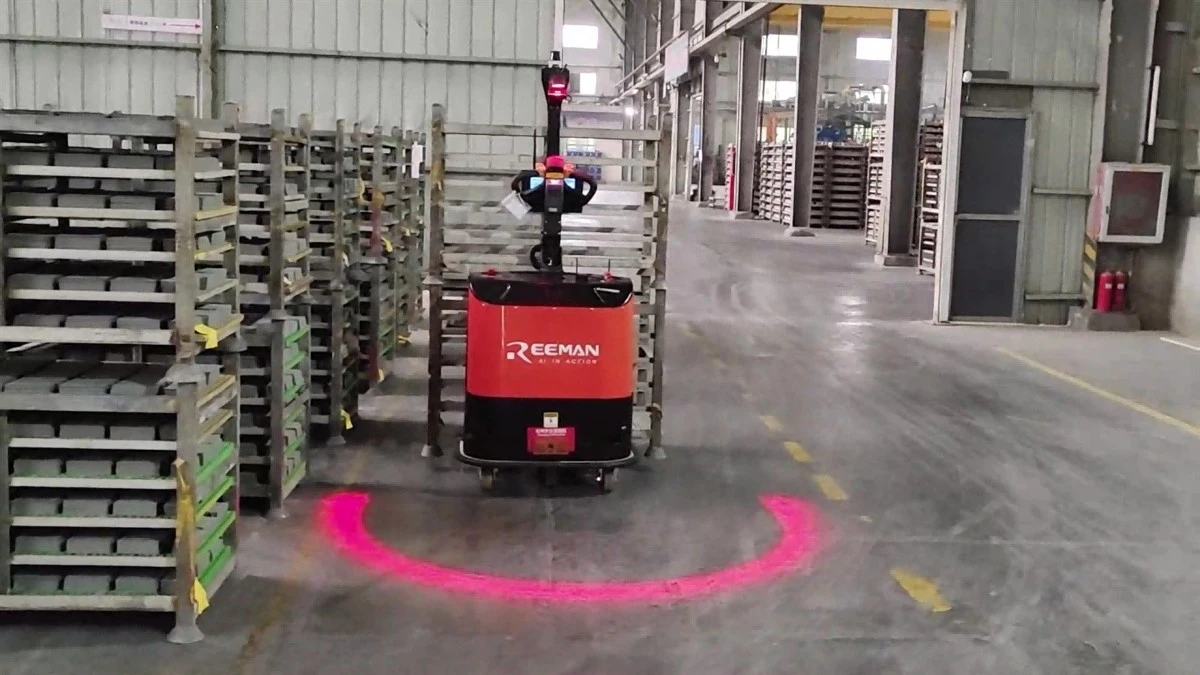
One Touch Starts the Task, Not Just the Vehicle
In this application, the call button is not a simple vehicle-summoning device. It is the entry point to a complete autonomous transport task. Before operation begins, the deployment engineer defines the pickup point, delivery point, autonomous route, pallet-handling sequence, charging location and task-completion behavior.
Once those settings are deployed, the employee only needs to press the corresponding button. Ironhide then executes the configured workflow without continuous remote driving.
How the One-Touch Call Button Communicates with Ironhide
The communication architecture can be selected according to the project. The button may communicate directly with Ironhide, transmit through a receiver, send the command through a gateway, or pass the request through a fleet-dispatch system.
The button sends a task-trigger command rather than continuous steering, speed or fork commands. The vehicle or dispatch layer matches the trigger with the task configured during deployment.
Button Press → Task Command → Vehicle / Receiver / Gateway / Dispatch System → Preconfigured Task → Autonomous Execution
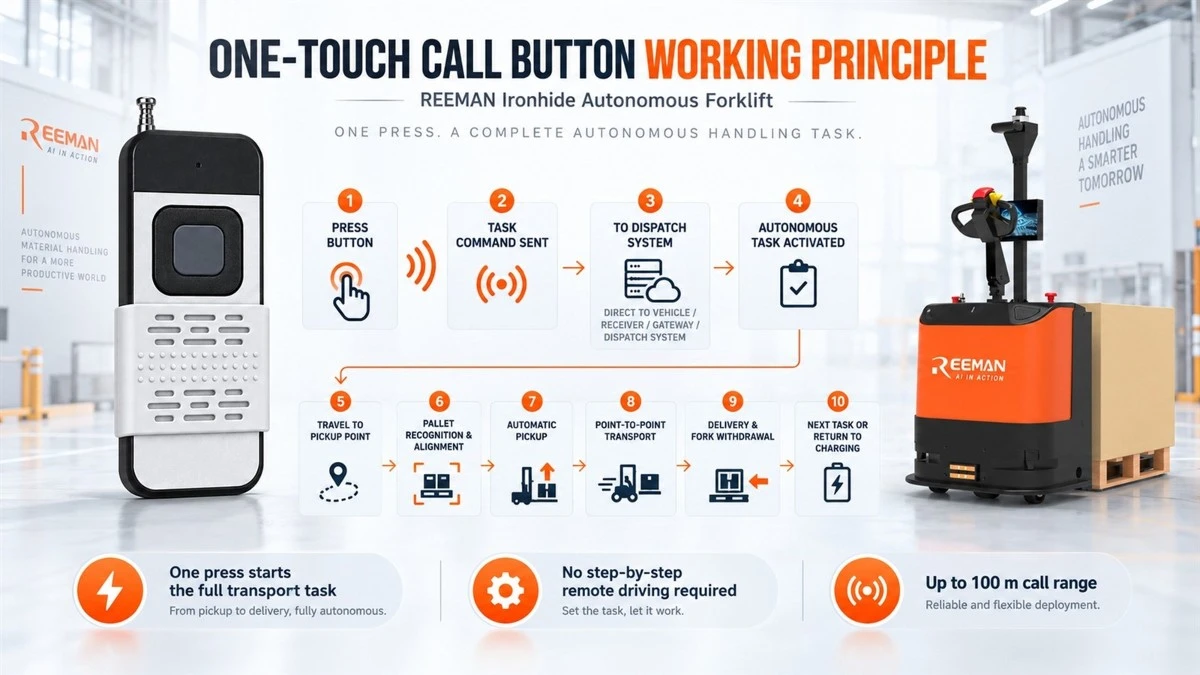
Complete One-Touch Workflow
|
Stage |
Ironhide Action |
Employee Action |
|
Task Request |
Receives call request |
Press button once |
|
Task Matching |
Loads predefined workflow |
None |
|
Travel to Pickup |
Autonomous navigation |
None |
|
Pallet Recognition |
Detects assigned pallet/load |
None |
|
Position Adjustment |
Fine-tunes vehicle pose |
None |
|
Fork Alignment |
Aligns with pallet openings |
None |
|
Automatic Pickup |
Lifts the load |
None |
|
Transport |
Travels to configured destination |
None |
|
Delivery |
Places pallet and withdraws forks |
None |
|
Task Queue Check |
Continues when another task is assigned |
None |
|
No Remaining Task |
Returns to charging point |
None |
Watch the Real One-Touch Calling Workflow
Video Chapters
- 00:00 One-Touch Remote Call Starts the Autonomous Forklift Task
- 00:13 First Autonomous Pallet Pickup & Transport Task
- 00:35 First Autonomous Pallet Delivery Completed
- 00:48 Second Assigned Autonomous Forklift Task
- 01:00 Second Autonomous Pallet Delivery Completed
- 01:14 Autonomous Forklift Return to Charging Point
1. First Autonomous Pickup and 47 m Transport
After receiving the call command, Ironhide autonomously travels to the first pickup location. At the pickup point, it performs pallet recognition, position adjustment, fork alignment and automatic pickup. The approximately 1.5-ton load is then transported along the configured route of about 47 meters to the assigned destination.
2. First Delivery: Placement and Fork Withdrawal
At the first delivery point, Ironhide positions the pallet, lowers the load and withdraws its forks. The first autonomous task is complete without the employee following the forklift or controlling the unloading action.
3. Second Assigned Task: Continue Without Manual Redispatch
After the first delivery, Ironhide checks the assigned task queue. If another job is already waiting, the forklift continues directly to the next operation instead of returning to charging. This continuous-task logic matters in a factory completing 160–200 transport tasks per day because repetitive jobs can be executed without repeated movement-by-movement dispatch.
4. No Remaining Task: Automatic Return to Charging
After the final delivery, Ironhide checks the task queue again. When no additional job is waiting, the forklift automatically returns to its designated charging point, closing the operating loop without manual parking or return driving.
One-Touch Call → Task Execution → Check Queue → Continue if Assigned → Return to Charging if Idle
Why 160–200 Trips per Day Creates a Strong Automation Case
A 47 m route is not long in isolation. The business case appears when the same movement is repeated 160–200 times per day. The assigned pickup-to-delivery distance alone equals approximately 7.52–9.40 km per day, before counting empty movement, repositioning, waiting, pickup, unloading or return travel.
The real workload is created by high frequency, repeated coordination and pallet handling. Short-distance, fixed-route, high-frequency tasks are particularly suitable for autonomous forklift deployment because the workflow can be standardized and repeated.
Overseas ROI Estimate Based on the Actual Huzhou Workload
The ROI model uses the actual Huzhou task volume and applies a representative overseas manufacturing labor-cost scenario. It is designed to answer the question an overseas buyer typically asks: how quickly can the equipment cost be recovered under a comparable high-utilization workload?
|
ROI Variable |
Base-Case Value |
|
Daily Tasks |
180 trips |
|
Recoverable Labor per Task |
3.5 minutes |
|
Operating Days per Month |
25 days |
|
Fully Loaded Labor Cost |
US$30/hour |
|
Equipment Reference Price |
US$9,900 |
|
Recoverable Labor Value |
50% |
|
Monthly Operating Allowance |
US$150 |
Base-Case Calculation
- Monthly direct labor value: 180 trips/day × 3.5 min/trip × 25 days ÷ 60 × US$30/hour = US$7,875/month.
- Recoverable labor value: US$7,875 × 50% = US$3,937.50/month.
- Monthly net value after the US$150 operating allowance: US$3,787.50/month.
- Estimated equipment-cost payback: US$9,900 ÷ US$3,787.50 = approximately 2.6 months.
ROI planning range: For overseas factories with comparable high-frequency task volumes, labor costs and equipment utilization, approximately 2–4 months can be used as an initial equipment-cost payback planning range. The final result depends on local labor cost, shifts, actual operator time per trip, utilization, installed scope and maintenance requirements.
How Much Repetitive Labor Can Be Reallocated?
Using approximately 3–4 minutes of direct manual involvement per trip, 160–200 daily tasks correspond to roughly 8–13 labor-hours per day. Across 300 operating days, that equals approximately 2,400–4,000 labor-hours per year, or around 1.2–2.0 full-time-equivalent positions of repetitive transport workload.
The operational value is not necessarily headcount reduction. The greater opportunity is to reassign repetitive forklift transport time to production, quality, maintenance, supervision or other higher-value work.
One-Touch Calling vs. Conventional Manual Dispatch
|
Process |
Conventional Method |
REEMAN One-Touch Workflow |
|
Request Transport |
Find forklift or contact driver |
Press one button |
|
Task Instructions |
Repeated manual communication |
Preconfigured |
|
Travel to Pickup |
Driver-operated |
Autonomous |
|
Pallet Recognition |
Driver judgement |
Autonomous workflow |
|
Fork Alignment |
Manual |
Automatic |
|
Pickup |
Manual control |
Automatic |
|
Transport |
Driver-operated |
Autonomous |
|
Placement |
Manual |
Automatic |
|
Next Job |
Manual redispatch |
Continues if assigned |
|
Return |
May require manual driving |
Automatic when idle |
|
Charging |
Operator involvement may be needed |
Automatic return to charging |
Does One-Touch Calling Require Factory-Wide Network Coverage?
No. The one-touch call function does not require factory-wide network coverage. The maximum call communication range in this configuration is up to 100 meters. This is the call-button communication range, not the maximum forklift route. After receiving the command, Ironhide follows the autonomous route configured during deployment.
FAQ
Q1: What does the one-touch call button actually do?
A: It activates a complete predefined autonomous transport task rather than simply summoning the forklift.
Q2: How does the button communicate with Ironhide?
A: Depending on the project, the button can communicate directly with the forklift or send the task through a receiver, gateway or fleet-dispatch system.
Q3: Does the operator need to keep controlling the vehicle?
A: No. After the task is triggered, Ironhide autonomously completes navigation, pallet recognition, fork alignment, pickup, transport, placement, fork withdrawal, subsequent assigned tasks and return to charging.
Q4: What is the route length in this application?
A: Approximately 47 meters per configured transport task.
Q5: How many transport tasks are completed per day?
A: Approximately 160–200 trips per day.
Q6: What is the actual transported load?
A: Approximately 1.5 tons in this application.
Q7: How much assigned transport distance does this represent per day?
A: Approximately 7.5–9.4 km/day based on the configured pickup-to-delivery route, excluding extra movement.
Q8: What happens if another task is waiting?
A: Ironhide continues directly to the next assigned task.
Q9: What happens when no task remains?
A: Ironhide automatically returns to its designated charging point.
Q10: Does the call function require factory-wide Wi-Fi?
A: No. Factory-wide network coverage is not required for the call function.
Q11: What is the maximum call range?
A: Up to 100 meters in this configuration.
Q12: Does the 100 m range limit the transport distance?
A: No. It only describes the call communication range.
Q13: What is the equipment reference price?
A: Approximately US$9,900 for the Ironhide Autonomous Forklift plus the one-touch call button, used as the equipment reference in this ROI model.
Q14: What is the estimated payback period?
A: Using the actual Huzhou task volume and a representative overseas labor-cost model, the estimated equipment-cost payback is approximately 2.6 months, with 2–4 months as an initial planning range for comparable high-frequency applications.
Product Reference
Learn more about REEMAN Ironhide Autonomous Forklift: REEMAN Ironhide Autonomous Forklift Product Page